

Key Takeaways
- Yes, you usually need full coverage on a financed car because most lenders require collision and comprehensive coverage.
- Full coverage helps protect both the lender’s investment and your own finances after theft, damage, or a total loss.
- Gap insurance can help if your car is totaled and you still owe more on the loan than the car is worth.
- If you drop required coverage, the lender may add costly CPI or force-placed insurance to your loan.
- You can usually drop full coverage only after the loan is fully paid off or the lender removes the requirement.
Introduction
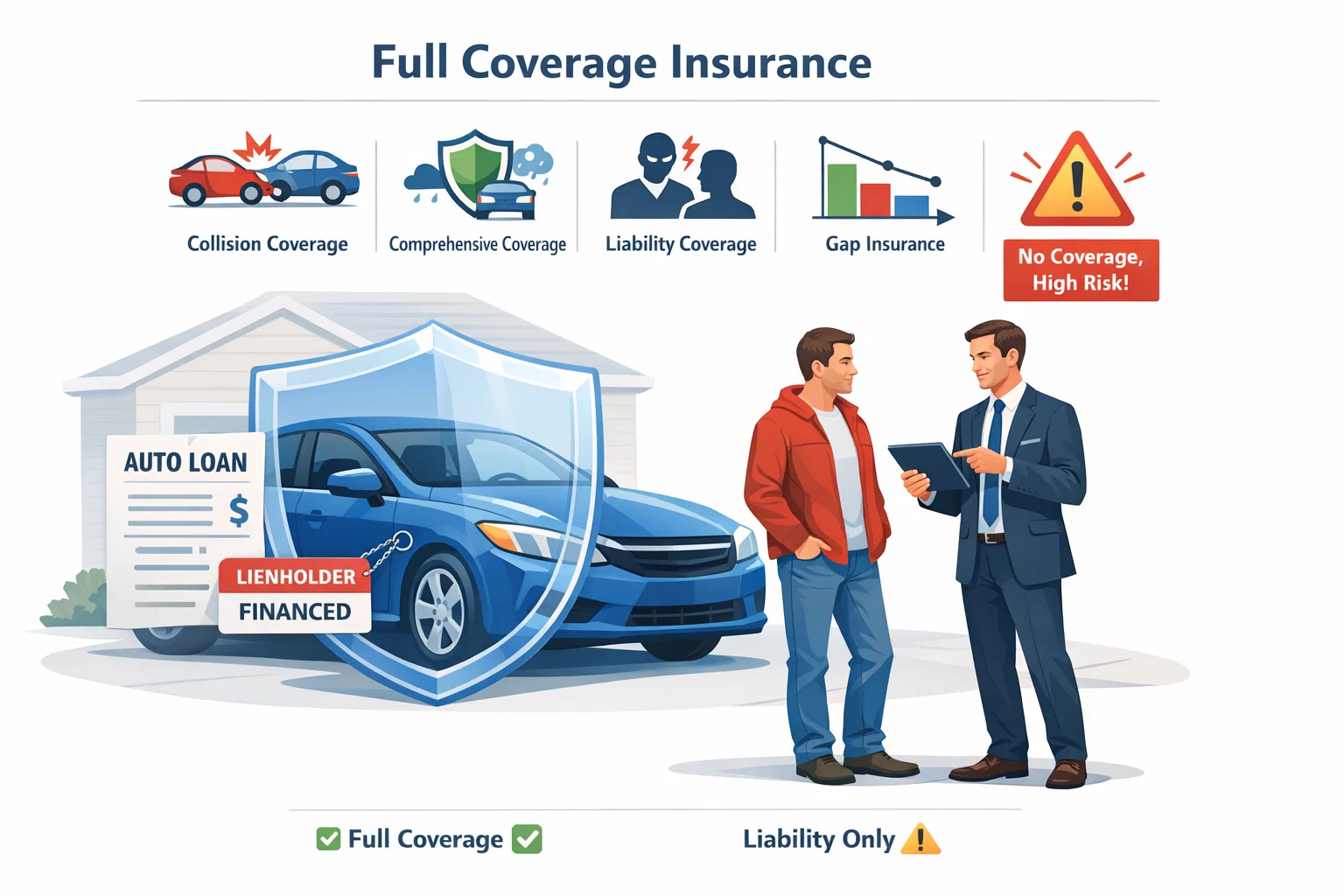
Yes, you usually need “full coverage” on a financed car because most lenders require collision and comprehensive coverage until the loan is paid off. GEICO says most lenders require “full coverage” on financed cars, and GEICO’s coverage pages explain that lienholders often require both collision and comprehensive coverage. GEICO also notes that “full coverage” is not one standard policy name, but a common way people describe a policy that includes liability, collision, and comprehensive coverage.
What Is “Full Coverage” Car Insurance?
“Full Coverage” usually means a policy that combines liability insurance, collision coverage, and comprehensive coverage. Liability pays for injuries or damage you cause to others. Collision helps repair or replace your car after a crash with another vehicle or object. Comprehensive helps pay for non-collision losses such as theft, hail, vandalism, flood, or hitting an animal. GEICO states clearly that there is no single official policy called full coverage, but people often use the phrase to describe that bundle of protection.
Do Lenders Require “Full Coverage” on Financed Cars?
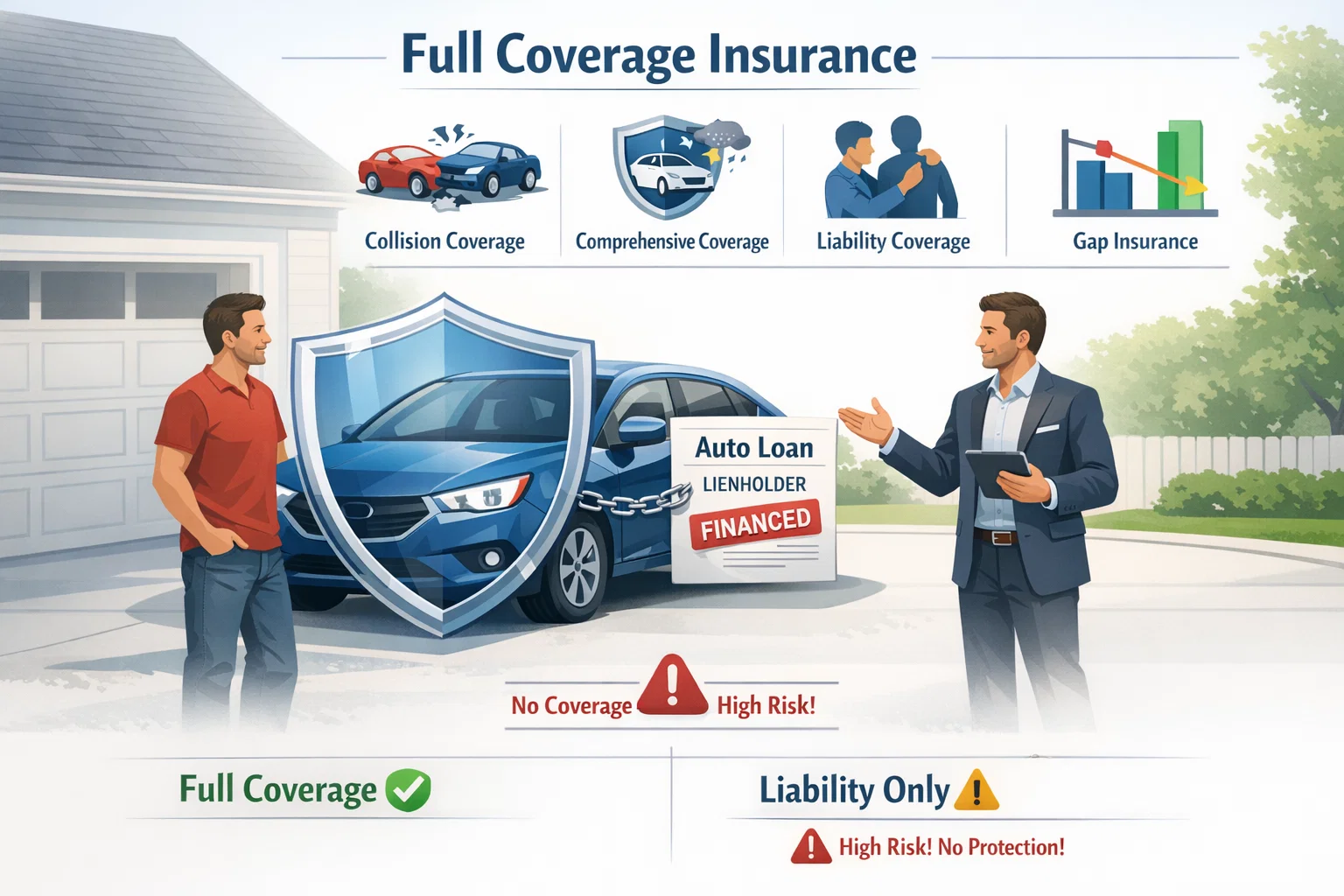
Yes, most lenders require “full coverage” on financed cars. GEICO says most lenders require it until the auto loan is completely paid off, and Bankrate says financed vehicles typically require full coverage to satisfy the loan or lease agreement.
Protecting the Lender’s Investment
The car is collateral for the loan. If the financed car is damaged, stolen, or totaled, the lender still wants the loan balance protected. That is why lenders usually require collision and comprehensive coverage instead of only liability insurance. GEICO explains that lienholders may require both coverages to protect their interest in the vehicle.
Protecting the Driver’s Financial Security
Full Coverage Car Insurance protects the driver too. If the financed car is badly damaged, liability-only insurance will not pay to repair your own vehicle. That can leave you making loan payments on a car you cannot drive. GEICO says maintaining broader coverage helps protect your own financial security, not just the lender’s interest.
The Role of Gap Insurance in Financed Cars
Gap Insurance is separate from Full Auto Insurance Coverage. Standard car insurance usually pays the actual cash value of the vehicle after a total loss. GAP is meant to cover the difference between what your insurer pays and what you still owe on the loan if that loan balance is higher than the vehicle’s value. The CFPB describes GAP as an optional product intended to cover that difference. (Consumer Financial Protection Bureau)
Why Gap Insurance Matters
Gap Insurance matters most when depreciation is faster than your loan payoff. That is common with low down payments, long loan terms, or rolled-over negative equity. If your financed car is totaled early in the loan, full coverage may still leave you owing money after the claim is paid. Bankrate and the CFPB both explain this gap-risk clearly. (Bankrate)
Lender Requirements and Recommendations
Some lenders require Gap Insurance, while others only recommend it. GEICO’s glossary says GEICO does not currently offer gap insurance and suggests checking with your financing company to see whether you already have it or whether it is available. That means lender rules and dealer contracts matter.
You Can Also Read Why Choosing Roofing Companies That Finance Can Help Avoid Upfront Costs
When You Can Drop Full Auto Insurance Coverage
You can usually drop lender-required Full Insurance Coverage only after the loan is paid off or the lender no longer requires it in writing. Before that point, removing coverage can violate your loan agreement. GEICO says most lenders require full coverage until the loan is completely paid off.
Evaluate Your Car’s Value
Once you own the vehicle outright, you can compare the car’s actual value against the cost of carrying collision and comprehensive coverage. If the car is older and the premium is high relative to the car’s value, dropping some physical-damage coverage may make sense. That is a personal cost-risk decision, not a lender decision. GEICO notes that comprehensive is often a smart investment for newer or more expensive vehicles.
Balance Risk and Cost
Balance risk and cost by asking 3 questions: How much is the car worth, how much would it cost you to replace it, and can you afford that loss out of pocket? If the answer to the third question is no, keeping more coverage may still be wise even after the loan ends.
Used or Pre-Owned Financed Car Considerations
A Used or Pre-Owned Financed Car usually still needs collision and comprehensive if the lender requires them. The fact that the car is older does not automatically remove the lender’s right to require broad protection. The loan agreement controls. The cost question changes with used vehicles, but the lender requirement often does not.
How GEICO Car Insurance Helps You Meet Lender Requirements
GEICO says drivers can combine liability, collision, and comprehensive coverage to meet lender requirements on financed vehicles. GEICO’s site also includes policy tools, My Account access, Claims support, Roadside Help, and Tools and Resources that can help policyholders manage Vehicle Insurance through Web and Mobile options. GEICO’s pages present this as a way to keep both the lender’s investment and the driver’s finances protected.
FAQs About “Full Insurance Coverage” on a Financed Car
Check Out a New Quote
Checking a new quote matters when your lender requires specific deductibles or broader protection. A lower premium is useful only if the policy still meets the lienholder’s rules. GEICO and other insurers usually let drivers compare coverage options before buying.
Learn More
Learn more by reviewing your loan agreement, your declarations page, and your lender’s insurance requirements. Those three documents tell you more than the phrase “full coverage” by itself.
What happens if you don’t keep full coverage on a financed car?
If you do not keep required coverage on a financed car, the lender may consider that a default under the loan agreement, may buy Collateral Insurance or Collateral Protection Insurance (CPI), and may add the cost to your loan balance or monthly payment. Bankrate explains that CPI is a lender-chosen safeguard when borrowers lack full coverage, and a credit union example explains that CPI only protects the vehicle and does not include liability or personal injury coverage.
Does GEICO offer full coverage insurance?
GEICO offers the coverages people commonly mean by full coverage, including liability, collision, and comprehensive coverage. GEICO also says there is no single official policy called full coverage. So the better question is whether GEICO offers the mix your lender requires, and the answer is generally yes. GEICO does not currently offer gap insurance, according to its glossary.
When should you drop full coverage on your car?
You should usually drop lender-required full coverage only after the car loan is paid off or the lender releases the requirement. After that, you can decide based on the car’s value, repair cost, theft risk, deductible comfort, and your budget. If the car is still worth enough that a total loss would hurt you financially, keeping broader coverage can still make sense.
What kind of coverage do you need for a financed car?
A financed car usually needs liability insurance, collision insurance, and comprehensive insurance. Some lenders or states make other coverages relevant too, such as uninsured and underinsured motorist coverage, while Gap Insurance may be required or recommended in some loans. GEICO says financed vehicles often need collision and comprehensive due to lender requirements, while New Mexico requires minimum liability insurance by law.
Financed car insurance requirements
Financed Car Insurance Requirements come from two places: state law and the lender. State law usually requires liability coverage. The lender usually adds physical-damage protection for the vehicle itself. That is why a financed car normally needs more than the legal minimum. (MVD New Mexico)
Collision insurance
Collision insurance helps pay to repair or replace your financed car after a covered crash with another car or object. GEICO says lienholders may require this coverage on financed or leased vehicles.
Comprehensive insurance
Comprehensive insurance helps cover non-collision losses such as theft, vandalism, hail, flooding, or hitting an animal. GEICO says lenders typically require comprehensive for financed or leased vehicles.
Bodily injury liability coverage
Bodily injury liability coverage pays for injuries you cause to other people. It is part of the legal minimum in most states. In New Mexico, the Motor Vehicle Division says drivers must carry minimum liability insurance of $25,000 for injury or death of one person, $50,000 for injury or death of more than one person, and $10,000 for property damage. (MVD New Mexico)
Underinsured and uninsured motorist coverage
Underinsured and uninsured motorist coverage can help when the at-fault driver has no insurance or not enough insurance. New Mexico’s Office of Superintendent of Insurance explains UM coverage as an add-on that can pay for injuries and damages caused by an uninsured driver, including hit-and-run situations. (osi.state.nm.us)
Full coverage auto insurance
Full coverage auto insurance is a common phrase, not a legal or standardized policy name. In everyday use, it usually means liability plus collision plus comprehensive. Some drivers add rental reimbursement, roadside help, or uninsured motorist coverage, but those are separate choices.
Do I need gap insurance on a financed car?
No, gap insurance is not always required, but it can be very valuable on a financed car if you owe more than the car is worth. The CFPB says GAP is optional, but some lenders and lease agreements require it. Gap Insurance is most useful early in the loan or when depreciation is steep. (Consumer Financial Protection Bureau)
Stay prepared on the road
Stay prepared by keeping your policy active, paying attention to lender notices, carrying proof of insurance, and reviewing deductibles. A financed vehicle creates two ongoing obligations: the car payment and the insurance requirement.
Tools & resources
Useful Tools & resources include your insurer’s My Account or GEICO Account portal, your lender’s insurance-tracking notices, your declarations page, and your state insurance department resources. Claims, Claims Center Location, Roadside Help, and coverage pages can all help you check whether your policy still matches the lender’s rules.
Can You Get Liability Insurance on a Financed Car?
Yes, you can technically get Liability Insurance on a financed car, but liability-only insurance usually does not satisfy the lender’s requirements. Parnall Law’s New Mexico article says liability insurance may meet state minimum legal requirements but usually does not provide the comprehensive protection lenders require. (Parnall Law)
What If I Crash a Car and Only Have Liability Insurance?
If you crash a financed car and only have liability insurance, your policy may pay for the other party’s covered damages, but it may not pay to repair your own financed vehicle. You could still owe the lender for the remaining loan balance while also facing repair or replacement costs. That is one of the biggest reasons lenders require collision and comprehensive. (geico.com)
Tips to Be Covered When Driving in New Mexico
In New Mexico, keep at least the legal minimum liability insurance, consider uninsured motorist coverage, and review whether your financed vehicle also needs collision, comprehensive, and possibly gap insurance. The New Mexico MVD lists the minimum liability rules, while OSI explains UM coverage and hit-and-run protection. (MVD New Mexico)
Need Help? Contact Parnall Law Today
If you were hurt in a crash in New Mexico and insurance questions are tied to an injury claim, Parnall Law presents itself as a New Mexico personal injury firm serving injured drivers. This legal-help section is more about accident claims than lender insurance rules. (Parnall Law)
Summary
Most financed cars need full coverage because lenders want the vehicle protected until the loan is paid off. The article explains what full coverage includes, why lenders require it, and how gap insurance can help after a total loss. It also covers what happens if coverage lapses, when you may be able to drop it, and how CPI works. The main point is simple: liability-only insurance is usually not enough for a financed car. Keeping the right coverage helps avoid major financial problems.
