

Key Takeaways
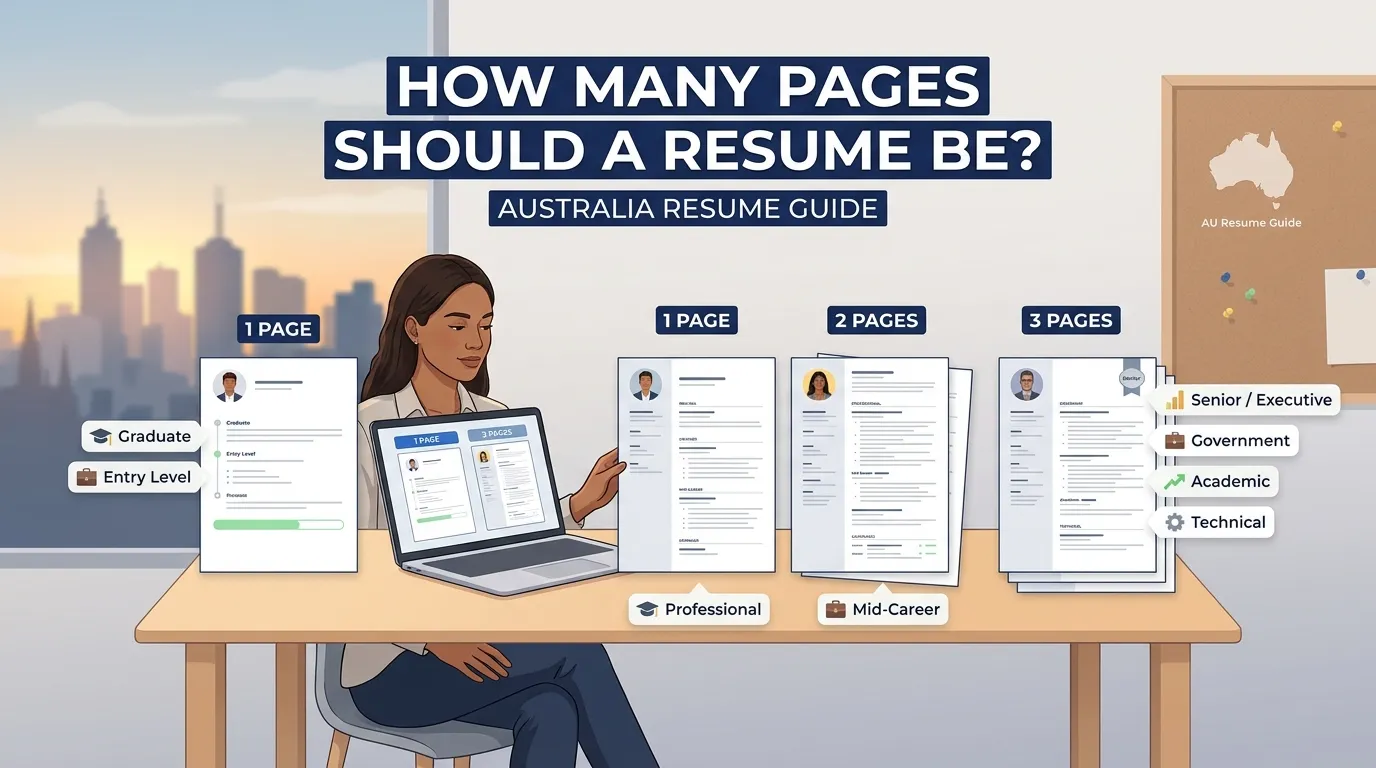
- A resume in Australia should usually be 1 page for graduates, 2 pages for most professionals, and 2–3 pages for senior or specialist roles.
- The best resume length depends on career stage, industry, relevance, and job requirements.
- A one-page resume works best for students, graduates, entry-level candidates, and creative roles with portfolios.
- A two-page resume is the best choice for most mid-career professionals with 5–15 years of experience.
- A three-page resume is acceptable for executives, government roles, medical roles, academic roles, and deep technical specialists.
- Applicant Tracking Systems (ATS) do not require a fixed page count, but resumes should use clear headings, keywords, and clean formatting.
Intro
A resume in Australia should usually be 1 page for graduates, 2 pages for most experienced professionals, and 2–3 pages for senior, executive, government, academic, medical, or technical roles. The answer to “how many pages should a resume be” depends on career stage, industry, relevance, and role requirements.
Resume length matters because recruiters need a clear reason to shortlist a candidate. A short resume can miss important achievements. A long resume can hide strong evidence under weak details. The right resume page count gives enough proof without wasting space.
Olivia Bennett
Executive Profile
Australian career documents specialist helping job seekers decide how many pages a resume should be in Australia based on experience level, industry, role seniority, and recruiter expectations. Skilled in building concise, ATS-friendly, achievement-led resumes that balance detail with readability.
AI & Tech Engine
Validated Credentials
Selected Achievements & Impact
Senior Resume Writer & Career Consultant
2021 – 2026- Resume Length Strategy: Reviewed 1,200+ Australian resumes and created tailored 1-page, 2-page, and 3-page resume structures based on career stage, industry, and job requirements.
- ATS Improvement: Increased client resume keyword alignment by 41% through targeted job ad analysis, role-specific skills mapping, and cleaner achievement formatting.
- Content Compression: Reduced oversized resumes from 5–6 pages to focused 2–3 page documents while retaining 95% of high-value achievements and measurable career outcomes.
Employment Services Advisor
2018 – 2021- Applicant Readability: Helped graduate, mid-career, and senior candidates restructure resumes for faster recruiter scanning, improving shortlist readiness across 18 job categories.
- Career Transition Support: Developed resume templates for healthcare, administration, education, construction, finance, IT, and government applicants across Australia.
- Document Quality: Standardised resume review checklists that reduced formatting errors by 36% and improved consistency across client applications.
Academic Architecture
Graduate Certificate in Career Development
2017 – 2018Bachelor of Communication
2014 – 2017Resume vs. CV: Understanding the Difference in Australia
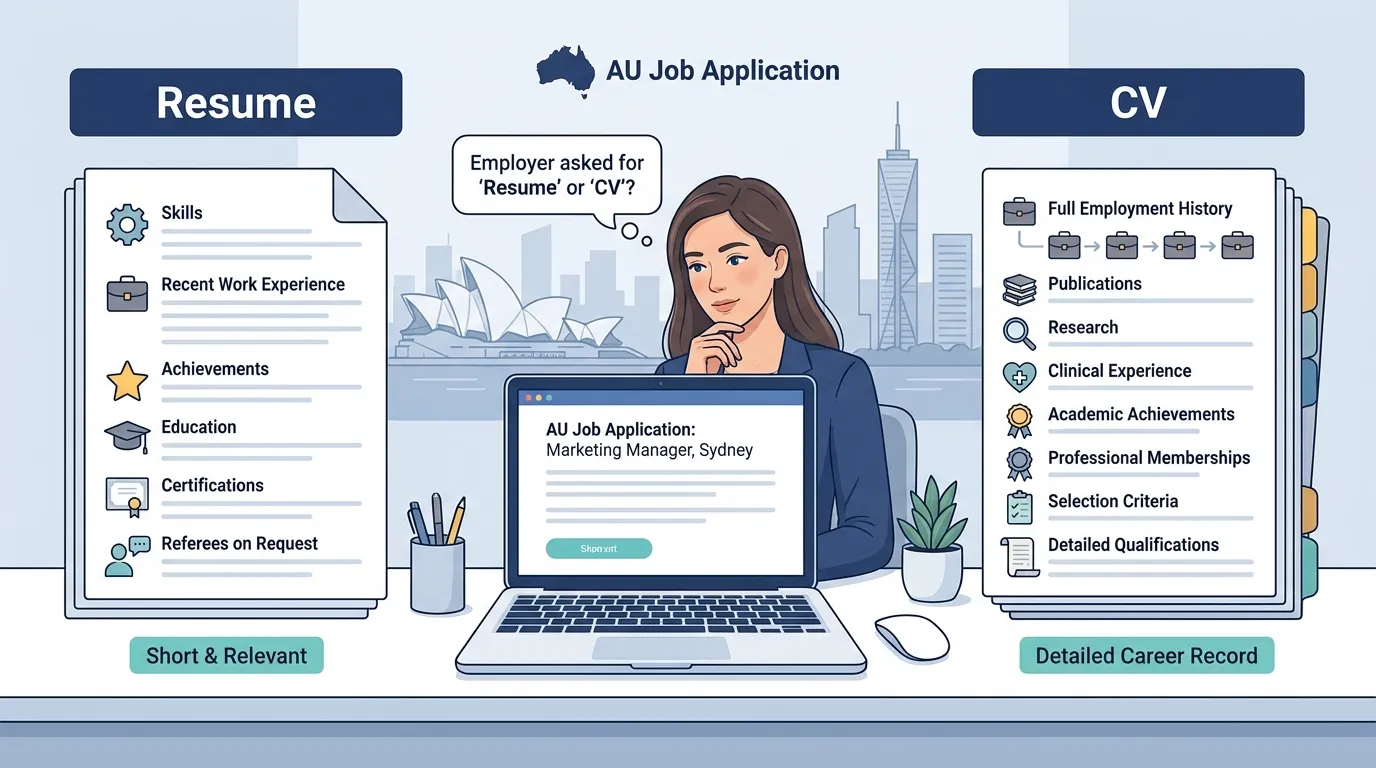
A resume is a short job application document focused on relevant skills, work history, achievements, and qualifications. A Curriculum Vitae (CV) is often longer and more detailed, especially for academic, research, medical, and government roles.
In Australia, the words resume and CV are sometimes used in the same way. Some employers ask for a “resume.” Some employers ask for a “CV.” Read the job ad before sending the document.
When to Use a Resume
Use a resume for most Australian Jobs in corporate, private sector, trade, retail, IT, marketing, customer service, administration, finance, and sales roles.
A resume works best when the employer wants:
- Recent work experience
- Skills
- Measurable achievements
- Education
- Certifications
- Referees or “available on request”
When to Use a CV
Use a CV for academic roles, medical roles, research roles, government applications, and some international applications.
A CV works best when the employer wants:
- Full employment history
- Publications
- Research work
- Clinical experience
- Academic achievements
- Professional memberships
- Selection criteria
- Detailed qualifications
Queensland Health, for example, provides a preferred medical practitioner CV template for RMO and Registrar applications, which shows that some healthcare applications need a more detailed CV format.
Comparison Table: Resume vs. CV
| Feature | Resume | CV |
|---|---|---|
| Main use | Most job applications | Academic, medical, research, government |
| Usual length | 1–3 pages | 3+ pages when needed |
| Focus | Relevant skills and achievements | Full career record |
| Detail level | Concise | Detailed |
| Best for | Corporate, IT, trade, marketing, private sector | Academic tenure tracks, medical training, government roles |
| Common terms | Resume Format, Australia resume example | Australian CV, Australian CV Format, Australia cv format 2026 |
The ideal resume length depends on career stage. A graduate does not need the same resume page count as an executive with 20 years of experience.
Early Career / Graduates (0-5 years): 1 Page
A 1-page resume is best for graduates and early-career candidates with 0–5 years of experience.
Use a one page resume when you have limited work history, internships, study projects, volunteer work, and entry-level skills. This applies to Graduate / Entry-Level candidates, college students, and many applicants seeking an Entry Level Resume Writing Service.
A 1-page resume should include:
- Contact details
- Professional summary or career objective
- Education
- Skills
- Internships
- Part-time jobs
- Projects
- Certifications
- Volunteer work
Use one-page resume if the second page contains weak, repeated, or unrelated details.
Mid-Career Professionals (5-15 years): 2 Pages
A 2-page resume is best for most Australian professionals with 5–15 years of experience.
Use a two page resume if you have enough relevant work experience, measurable achievements, and industry skills. This resume length gives space for a strong work history section without making the document too long.
A 2-page resume works well for:
- Software engineers
- Teachers
- Nurses
- Accountants
- Project coordinators
- Marketing specialists
- HR professionals
- Civil Construction Workers
- Mid-level managers
For 10 years of experience, 2 pages is usually the best resume length.
Senior Professionals and Executives (15+ years): 2-3 Pages
A 2–3 page resume is best for senior professionals and executives with 15+ years of experience.
Use 3 pages when the role requires leadership scope, major achievements, board work, large budgets, deep technical skills, or complex career history.
A Senior Professional & Executive Resume Writing Service often uses 2–3 pages because senior candidates need space for:
- Executive summary
- Leadership achievements
- Board of directors roles
- Major projects
- Budget responsibility
- Team size
- Industry change
- Strategic outcomes
- Awards
- Professional memberships
For 20 years of experience, 2–3 pages is usually acceptable. For 30 years of experience, 3 pages can work if every section supports the target role.
Resume Length by Industry in Australia
Resume length by industry in Australia changes because each sector values different evidence.
Government Roles
Government roles often need more detail than private sector roles. Use 2–3 pages for many government applications, and follow the application instructions if selection criteria are required.
During federal job applications or government security clearance, the resume may need exact dates, responsibilities, achievements, and qualifications. Queensland Government lists contact details, career strengths, employment history, education and training achievements, and referees as resume content areas.
Academic Roles
Academic roles often need a CV instead of a short resume. Use 3 pages or longer when the application requires publications, research, grants, teaching experience, conference work, and academic service.
For academic tenure tracks, a CV page count depends on the depth of research and teaching history.
Engineering and IT
Engineering and IT resumes usually work best at 2 pages for mid-career roles and 3 pages for deep technical specialists.
For a software engineer, the resume should show:
- Programming languages
- Frameworks
- Projects
- System impact
- Cloud tools
- Certifications
- Measurable results
A Software Engineer Career Guide or IT Careers in Australia resource can help candidates match Skills, Salaries, Pathways, and Job Opportunities to the target role.
Medical and Healthcare
Medical and healthcare resumes may be 2–4 pages depending on the role. Nurses, allied health workers, and administrators often use 2 pages. Doctors, registrars, researchers, and senior healthcare leaders may need a detailed CV.
For nursing, include clinical experience, registrations, specialist training, patient care achievements, and compliance knowledge.
Corporate / Private Sector
Corporate and private sector resumes usually work best at 2 pages. This applies to finance, administration, HR, sales, operations, customer support, and many management roles.
A Professional Resume and Cover Letter Service – Mid-Career usually keeps corporate resumes concise and achievement-focused.
Trade & Skilled Labor
Trade and skilled labor resumes are usually 1–2 pages. Use 1 page for early-career trade roles and 2 pages for candidates with licenses, safety training, project history, machinery experience, and site achievements.
For Mining and Resources, include tickets, site experience, safety record, equipment, rosters, and project types.
Creative and Marketing
Creative and marketing resumes are usually 1–2 pages. Use a 1-page resume if the portfolio carries most of the proof.
For creative portfolio roles, the resume should link to LinkedIn, a portfolio, campaigns, design samples, or case studies.
When to Use a One-Page Resume
Use a one-page resume if you are a graduate, early-career candidate, student, career changer with limited relevant experience, or creative candidate with a strong portfolio.
A 1-page resume works when the employer can understand your fit quickly.
For Graduates, Early Career, and Creative Roles with Portfolio
Use a one-page resume for:
- College students
- Graduate / Entry-Level applicants
- Candidates with under 5 years of experience
- Internship applications
- Apprenticeships
- Creative roles with visual resume supplements
- Candidates changing industries entirely with limited relevant experience
A one-page resume should not look crowded. Use a clean readable format and optimise white space.
When to Use a Two-Page Resume
Use a two-page resume if you have 5–15 years of relevant experience or enough achievements to support the job requirements.
A 2-page resume is the safest choice for most Australian professionals.
For Most Experienced Candidates in Most Sectors
Use a two-page resume for:
- Mid-career professionals
- Teachers
- Nurses
- Software engineers
- Accountants
- Project managers
- Corporate roles
- Trade supervisors
- Marketing managers
- HR advisors
- Business analysts
A two-page resume gives enough room for skills, achievements, work history, education, certifications, and selected additional sections.
When to Use a Three-Page (or Longer) Resume
Use a three-page resume or longer if the role requires detailed evidence, senior leadership history, technical depth, government selection criteria, academic work, or medical experience.
A 3-page resume is not wrong when the content is relevant.
For Executives, Deep Technical Specialists, and Government Applications
Use a three-page resume longer format for:
- Executive Resume applications
- Board of directors roles
- Consulting firm partners
- Deep technical specialists
- Government applications
- Academic roles
- Medical CVs
- Post-military transitions
- Executive career pivots
- Large project leadership
Do not use 3 pages to include every job duty. Use 3 pages to show relevant proof.
Factors That Influence Resume Length
Resume length rules depend on 5 main factors: experience, industry, relevance, formatting, and ATS.
Professional Experience
Professional experience affects resume page count more than age. A candidate with 8 strong years may need 2 pages. A candidate with 20 mixed years may still need 2 pages if older roles are not relevant.
Industry Norms
Industry norms relevance matters. Government, academic, medical, and technical roles often accept longer resumes. Creative, graduate, startup, and portfolio-heavy roles often prefer shorter resumes.
Relevance to the Position
Relevance is more important than length. Tailor resume length to the job description. Remove content that does not support the role.
Use this test:
- Keep details that prove fit.
- Cut details that repeat the same point.
- Shorten old roles.
- Remove outdated skills.
- Prioritise recent achievements.
Formatting and Readability
Formatting can make a 2-page resume feel short or a 1-page resume feel crowded. Use clean headings, readable font size, balanced spacing, and clear bullet points.
Good formatting includes:
- A4 page setup
- 10.5–12 pt font
- 1.5–2 cm margins
- Clear section headings
- Consistent dates
- Simple bullet points
- No dense paragraphs
Applicant Tracking Systems (ATS)
Applicant Tracking Systems (ATS) scan resumes for keywords, job titles, skills, and experience. ATS resume length has no perfect page count. ATS needs clear text, standard headings, and role keywords.
Use ATS optimization priority when applying online. Include keywords resume terms from the job ad, such as software, compliance, leadership, stakeholder management, customer service, or workplace safety.
Essential Sections of an Australian Resume
An Australian resume should include contact information, summary, skills, work experience, education, extra sections, and referees. Queensland Government lists contact details, career strengths, employment history, education and training achievements, and referees as key resume content areas.
Contact Information
Contact information should include:
- Full name
- Mobile number
- Email address
- Location, such as Sydney, Melbourne, Brisbane, Perth, Adelaide, or Australia
- LinkedIn URL
- Portfolio URL, if relevant
Do not include unnecessary personal details such as marital status, religion, or full street address.
Professional Summary / Career Objective
A professional summary works best for experienced candidates. A career objective works best for graduates and career changers.
Example:
“Customer service professional with 6 years of experience in complaint resolution, team support, and process improvement. Skilled in customer communication, CRM systems, and service reporting.”
Skills Summary
A skills summary should match the job ad. Include hard skills, soft skills, tools, and industry knowledge.
Example skills:
- Stakeholder communication
- Microsoft Excel
- Workplace Safety Compliance
- Customer service
- Project coordination
- Data reporting
- Team leadership
- ATS-friendly resume writing
- Remote Work communication
Work Experience (with Achievements)
The Australia work history section should focus on achievements, not only duties. Use measurable achievements bullet points when possible.
Use the XYZ Method:
“Achieved X result by doing Y, measured by Z.”
Example:
“Reduced monthly reporting time by 30% by creating a shared dashboard used by 8 team members.”
Education and Qualifications
Education should include:
- Degree or qualification
- Institution
- Graduation year, if recent
- Relevant coursework, if useful
- Professional Certificates
- Courses & Specializations
For career growth, platforms such as Coursera Plus, Coursera Staff Skills, Coursera Community, and Career Resources can support skills development.
Referees
In Australia, candidates can write “Referees available on request” or include referee details if the job ad asks for them.
For government roles, include referees when requested. For private sector roles, many candidates provide referees later in the hiring process.
Tips to Keep Your Resume Concise and the Right Length
Use these rule thumb tips to keep your resume clear, relevant, and the right length.
1. Limit Bullet Points to 3-7 Per Role
Use 3–7 bullet points for each recent role. Use fewer bullet points for older roles.
Best structure:
- 5–7 bullets for current or most relevant role
- 3–5 bullets for recent supporting roles
- 1–3 bullets for older roles
2. Focus on Achievements Rather Than Duties
Achievements prove value. Duties only explain tasks.
Weak bullet:
“Responsible for customer service.”
Better bullet:
“Resolved 40+ customer queries per day while maintaining a 95% satisfaction rating.”
3. Use Active Language and Be Concise
Use active verbs such as managed, reduced, improved, delivered, trained, created, resolved, led, and coordinated.
Keep each bullet to 1–2 lines.
4. Only Include Relevant Experience
Remove jobs, tasks, and details that do not support the target role. For a 15-year career, the most recent 10–12 years often need the most detail.
5. Include Keywords for ATS
Include keywords from the job ad. Match the employer’s wording where accurate.
Examples:
- Applicant Tracking Systems
- ATS
- Project management
- Customer experience
- Workplace Safety Compliance
- Civil Construction Jobs
- Software development
- Data analysis
- Stakeholder engagement
6. Consolidate Multiple Roles at the Same Employer
Group multiple roles at the same employer under one company heading. This saves space and shows promotion history.
Example:
Company ABC
Senior Analyst | 2023–2026
Analyst | 2020–2023
7. Remove Outdated or Irrelevant Content
Remove:
- Old school details after tertiary study
- Outdated software
- Unrelated short courses
- Old jobs with no relevance
- Generic hobbies
- Long duty lists
- References, unless required
8. Optimise Formatting (Font Size, Spacing, Margins)
Optimise formatting without making the resume hard to read. Do not use tiny font to force content onto one page.
Use:
- 10.5–12 pt font
- Simple headings
- Consistent spacing
- A4 size
- Clear margins
- Standard PDF file
9. Limit Education Details
Keep education short unless you are a graduate. Experienced candidates can list degree, institution, and year without long course details.
10. Seek Feedback from Others
Ask a recruiter, mentor, colleague, or resume writer to review clarity, length, and relevance. Tools such as CV360, LinkedIn Resume Builder, Resume Genius, Zety, and Indeed Resume can help with structure, but a human review can catch weak evidence.
Common Mistakes to Avoid in Australian Resumes
Avoid these resume mistakes:
- Using the same resume for every job
- Making the resume too long without relevant detail
- Forcing strong experience into 1 crowded page
- Listing duties without achievements
- Using unclear dates
- Adding personal details not needed for hiring
- Using graphics that ATS cannot read
- Hiding keywords in dense paragraphs
- Using US Resumes style without adapting to Australia
- Ignoring the job ad
- Leaving outdated skills
- Adding referees without permission
Formatting and File Setup for Australia (A4, Date Formats)
Use Australia style resume formatting for Australian job applications.
Recommended setup:
- Page size: A4
- File type: PDF unless the employer asks for Word
- Date format: Month Year, such as March 2024
- Location: City and state, such as Sydney NSW
- File name: FirstName_LastName_Resume.pdf
- Font: Arial, Calibri, Aptos, or similar
- Colour: Black text with limited accent colour
- Layout: Simple single-column or clean two-column layout
Avoid photos unless the employer or industry requests one. Most Australian CV and cover letter format expectations focus on skills, experience, and fit.
How Far Back Should Your Resume Go?
A resume should usually focus on the most recent 10–15 years of relevant experience.
Use more detail for recent roles and less detail for older roles. For senior candidates, older executive achievements can stay if they support the target role.
For a five year experience limit search, a 1–2 page resume works. For 10 years of experience, 2 pages works. For 20 years of experience, 2–3 pages works. For 30 years of experience, 3 pages works if the content is relevant.
How Often Should You Update Your Resume?
Update your resume every 6 months or whenever you change roles, finish a major project, gain a certification, or achieve a measurable result.
Update your resume during:
- Industry certification renewals
- Career pivots
- Recessionary hiring periods
- Promotion planning
- Salary negotiation
- Internal job applications
- LinkedIn profile updates
- Course completion
Regular updates make resume writing easier when a strong job opportunity appears.
Resume Templates and Examples
A resume template helps with structure, but content decides quality. Use an Australia resume format template that supports ATS, clean formatting, and achievement bullets.
Professional Summary Example
“Software engineer with 7 years of experience building web applications, APIs, and cloud-based systems. Skilled in JavaScript, React, Node.js, AWS, and Agile delivery. Known for improving system performance, reducing defects, and working with cross-functional teams.”
Work Experience Example
Software Engineer
ABC Company, Sydney NSW
March 2021 – Present
- Improved API response time by 28% by refactoring slow database queries.
- Delivered 4 product releases with Product Mobile and Resources Design Templates teams.
- Reduced production defects by 18% through code reviews and automated testing.
- Supported remote first companies through clear documentation and async updates.
- Mentored 3 junior developers during tech transitions.
Full Resume Structure Example
Full Name
Mobile | Email | LinkedIn | Location
Professional Summary
3–4 lines focused on role fit.
Skills
8–12 relevant skills.
Work Experience
Role, company, dates, location, 3–7 bullets per role.
Education
Degree, institution, year.
Certifications
Professional Certificates, Courses & Specializations, licenses.
Additional Sections
Awards, volunteering, memberships, languages, projects.
Referees
Available on request.
Role-Specific Examples (Mining, Graduate, Corporate)
Mining and Resources resume:
Use 2 pages. Include tickets, machinery, site experience, rosters, safety record, and measurable project outcomes.
Graduate / Entry-Level resume:
Use 1 page. Include education, internships, part-time work, projects, skills, and volunteer work.
Corporate resume:
Use 2 pages. Include professional summary, skills, achievements, work history, education, and certifications.
Summary
The best answer to “how many pages should a resume be” is 1 page for graduates, 2 pages for most experienced professionals, and 2–3 pages for senior, executive, technical, government, academic, or medical roles.
The right resume length is not about filling pages. The right resume length is about proof. Use a one-page resume if your experience is limited. Use a two-page resume if you have strong relevant experience. Use a three-page resume longer format if the role needs detailed evidence.
A strong Australian resume uses a clean readable format, measurable achievements bullet points, ATS keywords, relevant work history, and clear formatting. Tailor resume length to each job and remove anything that does not help the employer say yes.
