

Key Takeaways
- An Australian resume is 2 pages, uses no photo or date of birth, follows British spelling, and leads with an achievement-focused opening statement tailored to each role.
- Your opening statement, key skills section, and work experience bullet points must mirror the exact language from the job listing to pass ATS screening before a human reads your resume.
- Quantifying achievements with numbers, percentages, dollar values, and timeframes is the single most effective way to make your professional experience stand out from other applicants.
- Tailoring your resume for each application means adjusting your opening statement, reordering your skills list, and editing your top two roles to reflect the specific requirements of that job.
- Students, career changers, and candidates with gaps all have effective resume formats available functional, combination, and chronological and no situation requires you to hide your history.
Intro
Most Australian resumes get rejected before a recruiter ever reads them not because the candidate is underqualified, but because the document is formatted wrong, missing the right keywords, or written for the wrong market.
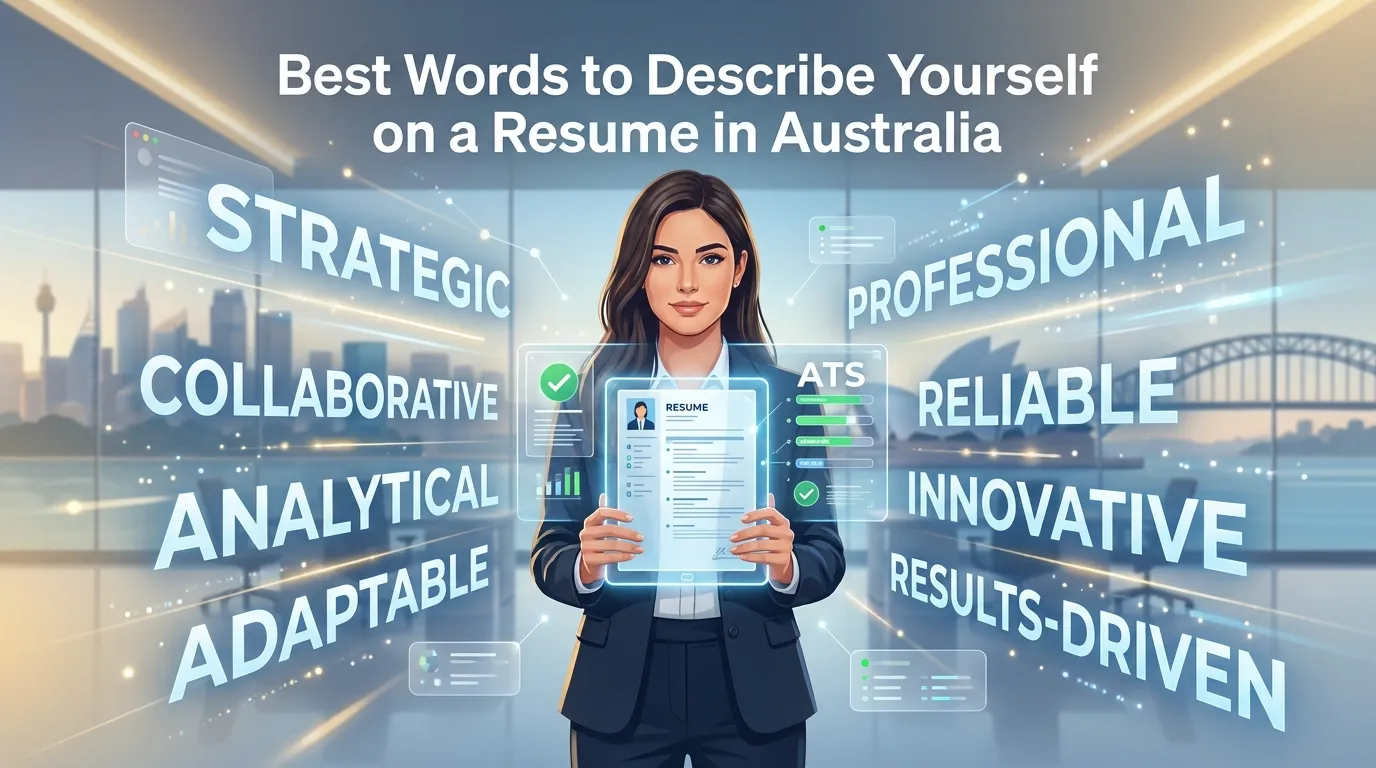
Knowing exactly how to describe yourself on a resume in Australia means understanding what local employers expect, how ATS software scores your application, and which words actually get you to interview.
This guide gives you every section, every format, and every rule so your resume works harder from the moment it’s submitted.
Understanding the Australian Job Market
Key Differences in Australian Resumes
An Australian-style resume differs from resumes written for the US, UK, or other markets in several clear ways.
Australian resumes are typically two pages for most roles. US resumes often run to one page; UK CVs can run much longer. Two pages is the accepted standard in Australia for mid-career professionals, with one page acceptable for students and graduates and up to three pages only for executives or senior specialists.
Australian employers do not expect a photograph on a resume. Including one is unusual and may introduce unconscious bias. Similarly, date of birth, marital status, and nationality are not required and should be left off.
The tone in Australian resumes is direct and achievement-focused rather than dutiful. Employers want to see what you did and what resulted, not just a job description of duties.
Spelling follows Australian English conventions. This means “organise” not “organize,” “colour” not “color,” and “programme” when referring to a structured course of study. SEEK, the dominant Australian job board, indexes resumes using Australian spelling, so inconsistency can affect ATS matching.
Essential Skills Australian Employers Value
Australian employers consistently prioritise 6 categories of skills across most industries:
- Communication skills (verbal and written): The ability to convey information clearly in team meetings, written reports, and client correspondence.
- Teamwork and collaboration: Contributing to cross-functional and hybrid team workflows.
- Problem-solving: Identifying issues and proposing workable solutions, especially under time pressure.
- Adaptability: Responding to policy changes, seasonal demand shifts, and evolving business needs.
- Digital literacy: Proficiency in industry-standard software, cloud tools, and data platforms.
- Cultural competence: Awareness of Australia’s diverse workforce, including protocols relevant to Indigenous communities.
Roles in mining, construction, and remote sites add safety awareness as a non-negotiable attribute. Healthcare and aged care roles weight empathy and patient-centred care heavily. Government and public sector positions value written communication, documentation for audit readiness, and policy interpretation.
CV vs Resume in Australia
In Australia, the terms CV (curriculum vitae) and resume are used interchangeably by most employers, recruiters, and job boards. Both refer to a two-page document summarising your professional history and skills.
A formal academic CV which is longer and lists publications, research outputs, conference presentations, and grants is used only for academic, research, and some senior medical positions. For all other roles, treat “CV” and “resume” as the same thing.
Lachlan McKenzie
Executive Profile
Highly accomplished Operations professional with a track record of driving efficiency in fast-paced Australian corporate environments. Expert in aligning executive strategy with day-to-day operational excellence, stakeholder management, and digital transformation.
AI & Tech Engine
Validated Credentials
Selected Achievements & Impact
Senior Operations Manager
2021 – 2026- Operational Efficiency: Streamlined cross-departmental reporting, reducing month-end processing time by 25%.
- Tech Integration: Orchestrated the firm-wide migration to AI-driven workflow tools, boosting team productivity by 18% within the first quarter.
- Stakeholder Engagement: Served as primary liaison for board-level reporting, ensuring 100% compliance with local corporate governance requirements.
Executive Support Lead
2017 – 2021- Process Improvement: Revamped internal documentation systems, achieving a 40% reduction in document retrieval latency.
- Relationship Management: Effectively managed a high-volume executive diary, ensuring zero scheduling conflicts across 15+ concurrent project streams.
Academic Architecture
Bachelor of Business
2013 – 2017HSC Certification
2012Preparing to Write Your Resume
What You Will Need
Before writing your resume, gather the following information:
- Full name, phone number, email address, suburb and state (no street address needed), and LinkedIn profile URL.
- The exact job title and reference number for the role you are applying for.
- The full text of the job advertisement, including the key selection criteria.
- Your complete employment history: employer name, your job title, dates of employment, and 3–5 bullet-point achievements for each role.
- Your full education history: institution name, qualification title, year completed or expected completion date.
- Names and contact details of 2–3 referees who have agreed to be contacted.
- Any certifications, licences, or professional memberships relevant to the role.
- Visa status and work rights, if you are an international student or temporary resident.
Overview of the Australian Job Application Process
The Australian job application process follows 5 main steps:
- Job search: Most roles are advertised on SEEK, LinkedIn Australia, SEEK Grad, and GradConnection. Agencies like Hays also list roles across industries.
- Application: Submit a tailored resume and cover letter through the employer’s portal, via email, or through the job board. Some government and large corporate roles require a separate key selection criteria response.
- ATS screening: Most medium and large employers use an applicant tracking system to filter resumes before a recruiter reads them. Your resume must contain the right keywords to pass this stage.
- Interview: Shortlisted candidates are invited to a phone screen, video interview, or face-to-face interview. The Hays Interview Guide recommends preparing structured answers to common behavioural questions using the STAR (Situation, Task, Action, Result) method.
- Reference checks and offer: Employers check at least two referees before making a formal offer.
Weak Resume Words vs Better Alternatives
| Weak Word | Better Alternative | Why It’s Better |
|---|---|---|
| Hardworking | Results-Driven | Sounds more measurable |
| Team Player | Collaborative | More professional wording |
| Responsible For | Managed / Led / Delivered | Strong action verbs |
| Good Communicator | Articulate / Persuasive | More specific |
| Fast Learner | Adaptable | Shows flexibility |
| Go-Getter | Proactive | ATS-friendly and professional |
Resume Structure and Format
Choosing the Right Resume Format
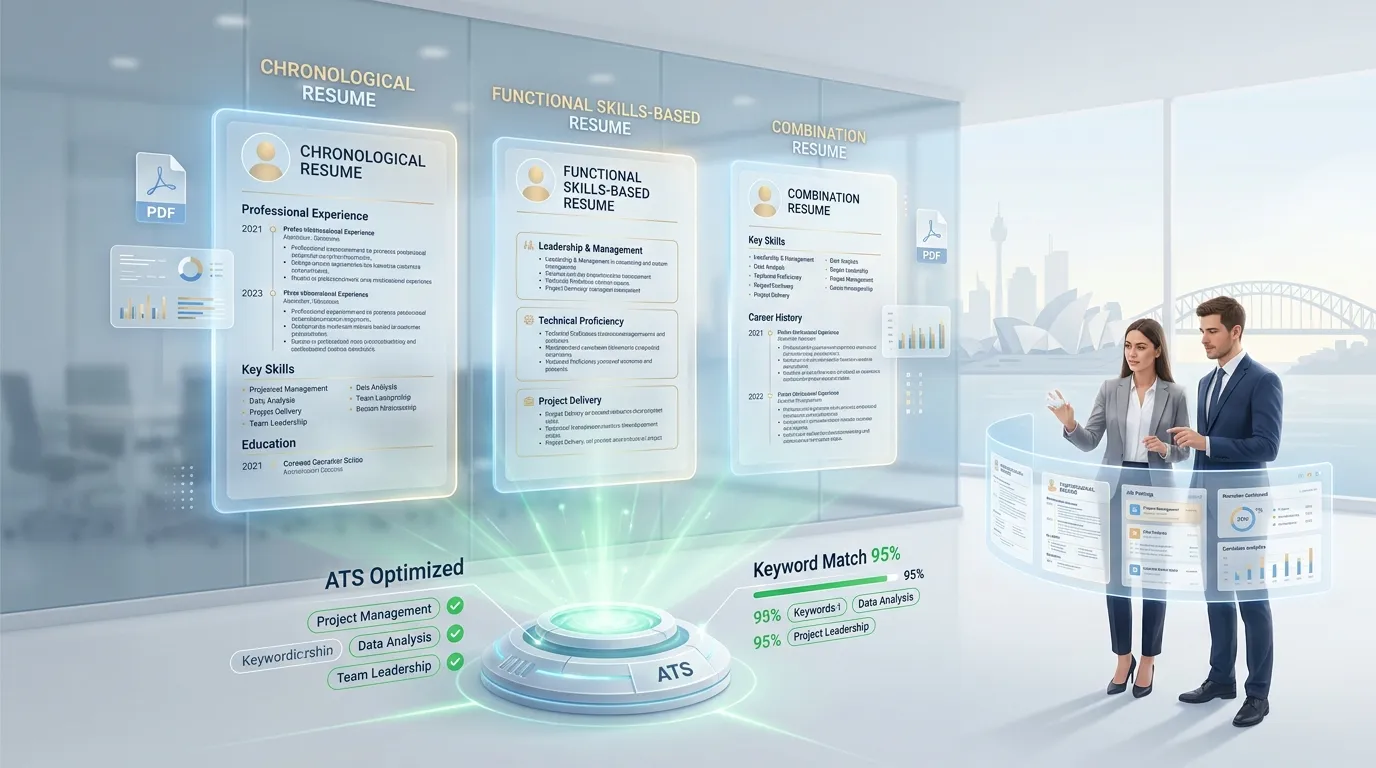
There are 3 main resume formats used in Australia:
Chronological: Lists your professional experience from most recent to oldest. This is the most common format in Australia and the format most ATS software reads reliably. Use it when your work history is consistent and relevant to the role.
Functional (Skills-Based): Groups experience under skill headings rather than job titles. Use this format for career changes, when returning to work after a career gap, or for resumes with no direct experience in the target role.
Combination: Leads with a strong skills summary followed by a chronological work history. This format suits career changers and experienced candidates moving into a related but different role.
For most applicants, the chronological format is the safest and most effective choice.
Ideal Resume Length
The ideal length for an Australian resume is 2 pages for most applicants. There are 4 specific situations where length varies:
- Students and graduates with no experience: 1 page.
- Entry-level candidates with some work history: 1–2 pages.
- Mid-career professionals: 2 pages.
- Executives and senior specialists: Up to 3 pages.
Never pad a resume to fill space. Recruiters and hiring managers notice filler content, and it weakens an otherwise strong application.
Best Fonts and Design Principles
Use one of 4 clean, widely supported fonts: Calibri, Arial, Garamond, or Cambria. Font size should be 10–12pt for body text and 14–16pt for your name and section headings.
Keep the design simple. White space improves readability and makes it easier for a recruiter scanning quickly to find the information they need. Avoid multiple columns, text boxes, graphics, tables, headers, and footers because ATS software cannot reliably read content inside these elements.
Use bold to highlight section headings and your name. Use bullet points for achievements and responsibilities. Avoid underlines except for hyperlinks and avoid italics except for institution names and publication titles.
Save and send your resume as a PDF unless the employer specifies otherwise. PDF versions preserve formatting across devices.
Layout and Ordering
The standard layout for an Australian resume follows this order:
- Contact details
- Opening statement (career objective, profile summary, or About Me section)
- Key skills and strengths
- Professional experience
- Education and qualifications
- Referees (or “References available on request”)
- Optional sections (interests/hobbies, certifications, testimonials, visa status)
This order puts your most relevant, readable content at the top where recruiters spend the most time.
ATS (Keyword) Optimisation
An applicant tracking system (ATS) scans resumes for specific keywords before a human reads them. There are 5 practical steps to optimise your resume for ATS:
- Read the job advertisement and highlight the key skills, qualifications, tools, and phrases the employer uses.
- Incorporate those exact phrases into your resume naturally in your opening statement, key skills section, and job bullet points.
- Use standard section headings such as “Professional Experience,” “Education,” and “Key Skills.” Non-standard headings confuse some ATS platforms.
- Avoid placing content in headers, footers, tables, or text boxes, as many ATS tools skip these areas entirely.
- Submit a clean, text-based PDF or Word document not an image-based file or a heavily designed template.
Using keywords from job listings does not mean copying the advertisement word for word. It means mirroring the language naturally throughout your document.
What to Include in Your Resume
Contact Details
Your contact details belong at the top of page one. Include these 5 elements:
- Full name: Use the name you are known by professionally.
- Phone number: A mobile number you answer reliably.
- Email address: A professional address using your name, not a nickname.
- Suburb and state: No street address is needed. “Fitzroy, VIC” or “Surry Hills, NSW” is sufficient.
- LinkedIn profile URL: Ensure your LinkedIn profile is up to date and consistent with your resume before submitting.
Do not include your date of birth, photograph, marital status, religion, or ethnicity. These details are not required in Australia and may expose the hiring process to bias.
Opening Statement / Career Objective / About Me
The opening statement is the first section a recruiter reads after your contact details. It is 3–5 sentences (or up to 80 words) that summarise who you are professionally, what you offer, and what you are looking for.
This section appears under several names: opening statement, career objective, profile summary, About Me section, or resume objective. All refer to the same concept.
Writing a Compelling Personal Statement
A compelling personal statement does 3 things:
- States your professional identity (job title, years of experience, or field of study).
- Highlights your strongest 2–3 skills or achievements relevant to the role.
- States your career goal or the value you bring to the employer.
Example for a mid-career professional: “Registered nurse with 7 years of experience in acute care settings, specialising in post-operative patient management. Consistent record of strengthening cross-functional trust between surgical and ward teams to reduce patient handover delays. Seeking a senior clinical role where deep technical expertise and a patient-first approach contribute to improved care outcomes.”
Example for a graduate: “Recent commerce graduate from Deakin University with a major in accounting and a strong foundation in financial reporting and data analysis. Completed a 10-week internship at a regional accounting firm, preparing tax returns and assisting with audit documentation. Looking for a graduate accountant role where analytical skills and attention to detail add value from day one.”
Career Objective vs Profile Summary
A career objective focuses on what you want from the role. It suits entry-level candidates and career changers who need to explain a shift in direction.
A profile summary (also called a professional summary) focuses on what you offer the employer. It suits mid-career and experienced professionals whose credentials speak for themselves.
Use a career objective when you are a student, new graduate, or making a significant career change. Use a profile summary when you have 3 or more years of relevant experience.
Key Skills and Strengths
The key skills and strengths section gives ATS software and recruiters a fast snapshot of your core capabilities. It typically appears as two columns of 6–10 bullet points.
Technical/Software Skills
Technical skills are measurable, teachable abilities tied to specific tools, systems, or processes. List the software, platforms, and technical competencies relevant to the role. For example:
- Microsoft Excel (advanced pivot tables, VLOOKUP, macros)
- Python (data wrangling, automation scripts)
- Salesforce CRM (lead management, pipeline reporting)
- AutoCAD 2024 (2D drafting, site layout planning)
- Xero and MYOB (accounts payable/receivable, payroll)
Do not list basic skills such as “email” or “internet browsing” unless the role specifically requires digital literacy training, such as in aged care or community support work.
Human Skills / Personal Attributes
Human skills (often called soft skills or personal attributes) describe how you work with people and solve problems. Include 4–6 of the most relevant attributes for the role. Common and credible examples include:
- Verbal and written communication skills in multi-stakeholder environments
- Adaptability to seasonal demand shifts and changing priorities
- Mentoring junior team members through organisational change
- Integrating feedback from frontline staff into operational improvements
- Balancing competing priorities without losing attention to detail
Avoid overused phrases such as “team player,” “hard worker,” and “results-driven” without evidence. Every attribute you list should be supported by a specific example somewhere in your professional experience section.
Best Professional Words by Skill Type
| Skill Area | Best Resume Words | Why They Work |
|---|---|---|
| Leadership | Strategic, Decisive, Influential, Reliable | Show management and decision-making ability |
| Communication | Articulate, Collaborative, Persuasive, Diplomatic | Highlight teamwork and people skills |
| Problem Solving | Analytical, Resourceful, Innovative, Logical | Demonstrate critical thinking |
| Work Ethic | Dedicated, Dependable, Proactive, Motivated | Show responsibility and consistency |
| Technical Roles | Detail-Oriented, Methodical, Efficient, Skilled | Important for IT, engineering, and operations |
| Customer Service | Friendly, Patient, Supportive, Professional | Shows client-facing strengths |
Using Action Verbs and Describing Words
Strong bullet points begin with an action verb in the past tense for previous roles and the present tense for current roles. There are 20 highly effective action verbs for Australian resumes:
Achieved, Coordinated, Delivered, Developed, Facilitated, Implemented, Improved, Led, Managed, Negotiated, Optimised, Produced, Reduced, Resolved, Streamlined, Supervised, Supported, Trained, Translated, Transformed.
Use describing words (adjectives and adverbs) sparingly. One precise verb beats two vague modifiers. “Reduced onboarding time by 30% through a revised induction checklist” is stronger than “Greatly improved the very important onboarding process.”
Professional Experience
Professional experience is the most important section of your resume. List your roles in reverse chronological order most recent first.
For each role, include:
- Job title
- Employer name and location (city/state, not full address)
- Dates of employment (month and year)
- 3–6 bullet points describing your responsibilities and achievements
Detailing Work Experience Effectively
Each bullet point should describe a specific action you took and the result it produced. Use the formula: Action + Task/Situation + Result.
Weak: “Responsible for managing customer complaints.” Strong: “Resolved an average of 25 customer complaints per week, achieving a 94% first-contact resolution rate and reducing escalations to the team leader by 40%.”
Focus on achievement, not duty. A duty is what the role required; an achievement is what you specifically contributed.
Quantifying Achievements
Quantifying achievements makes your resume more credible and more memorable. Where possible, include numbers, percentages, dollar values, and timeframes. There are 5 types of quantifiable achievement:
- Volume: “Processed 150 invoices per week with 99.8% accuracy.”
- Improvement: “Reduced processing time by 22% through a revised workflow.”
- Revenue/cost: “Identified a supplier consolidation opportunity saving $45,000 annually.”
- Scale: “Managed a team of 12 across 3 state offices.”
- Outcome: “Delivered the project 3 weeks ahead of schedule.”
Not every bullet point needs a number. But aim for at least 2–3 quantified achievements per role.
Including Volunteer and Extracurricular Activities
Volunteer work, community involvement, and extracurricular activities count as relevant experience, especially for students and graduates. List them in the same format as paid work. Include the organisation name, your role, dates, and 2–3 bullet points describing what you did.
Organisations such as IDP Education student community events, university clubs, sporting associations, and charity drives all demonstrate transferable skills: leadership, communication, event coordination, and teamwork.
Education and Qualifications
List your education in reverse chronological order. For each qualification, include:
- Qualification title: e.g., Bachelor of Commerce (Accounting)
- Institution name: e.g., La Trobe University, Deakin University, ANU (Australian National University), University of Edinburgh, University of St Andrews
- Year of completion or expected completion: e.g., 2024 (Graduated) or 2026 (Expected)
- Relevant coursework, major, or distinction: if applicable and relevant to the role
For professional certifications, include the issuing body and the date of issue or expiry. For trades qualifications, include the certificate level and the registered training organisation (RTO) name.
If you completed secondary school in Australia, include your Australian Tertiary Admission Rank (ATAR) only if you are a recent school leaver and the role requires it. Experienced professionals should omit secondary school education entirely.
Referees and References
Include 2–3 referees at the end of your resume. For each referee, include:
- Full name and job title
- Organisation name
- Phone number
- Email address
- Your relationship to the referee (e.g., “Direct supervisor at Telstra, 2021–2023”)
Always ask permission before listing a referee. If you are not comfortable listing contact details publicly, write “References available upon request” and prepare the details to share when asked.
A strong referee is someone who has directly supervised your work or collaborated closely with you. Do not use personal friends, family members, or character references unless the role specifically asks for them.
Summary
Writing an effective Australian resume comes down to clear structure, targeted language, and evidence-backed achievements that match what the employer is asking for. Whether you are a graduate, a career changer, or an experienced professional, the same principles apply: tailor every application, quantify your results, and keep the formatting clean and ATS-friendly. Follow this guide and your resume will consistently represent you at your strongest.
