

Key takeaways
-
No GRE required is common in online MSEd/M.Ed. admissions, but some programs apply GPA or licensure conditions.
-
Check institutional accreditation (example: Higher Learning Commission (HLC)) and, if relevant, CAEP alignment for educator-prep quality signals.
-
Pick a specialization that matches the job: curriculum and instruction, educational leadership, special education, science education, or digital teaching and learning.
-
Compare real cost using transfer credits, employer benefits, and tuition programs like the University System of Georgia Tuition Assistance Program (TAP) when eligible.
-
Build an admissions checklist early and set a personal target date (example: February 23, 2026) to avoid last-minute transcript delays.
Many universities offer online master’s in education programs with no GRE required. The fastest path is to shortlist schools, confirm the GRE policy on the program’s admissions page, then compare specialization, format, and accreditation.
Quick list: online master’s in education programs that state “no GRE required”
The programs below publicly state a no-GRE (or no standardized test) requirement on their official pages as of February 2026.
| University | Example online education master’s program | GRE policy stated on program page |
|---|---|---|
| Pepperdine University (Graduate School of Education and Psychology) | Online Master of Science in Education (MSEd) | “No GRE or standardized tests required” |
| Purdue Global | Master of Science in Education (MS in Education) | “No GRE required” (program FAQ) |
| University of New England (UNE Online) | Master of Science in Education (MSEd) | “No GRE is required for admission” |
| University of Kansas (KU School of Education & Human Sciences) | Online master’s (M.S.E.) options (e.g., Curriculum & Instruction; Ed Admin) | “No GRE required for admission” (program pages) |
| Capella University | Online Master of Science in Education | “No GRE required” |
| Western Governors University (WGU) | Online M.Ed. programs (competency-based) | “No standardized testing required” (includes GRE) |
| Ball State University | Online M.Ed. options | “No GRE required” (program pages) |
| University of North Texas (UNT) | Online M.Ed. programs | “GRE not required” (noted with conditions on some tracks) |
| Liberty University | Online master’s programs (incl. education) | States GRE not required for online master’s programs |
| Southern New Hampshire University (SNHU) | Online master’s programs (incl. education areas) | States no GRE/GMAT requirement for master’s admissions |
| University of Georgia (UGA) | Online M.Ed. in Educational Administration & Policy | States no GRE/MAT test scores required |
If a school says “GRE waived,” treat that as different from “no GRE required.” The next section shows how to verify the difference.
What “No GRE Required” means in online education master’s admissions
“No GRE required” means the program does not ask for Graduate Record Examination (GRE) scores as part of the application. Pepperdine’s online MSEd page, for example, states no GRE or standardized tests required.
No GRE vs. GRE waived vs. GRE optional
-
No GRE required: the program does not request GRE scores for applicants (the cleanest policy).
-
GRE waived: the program normally requires GRE scores, but removes the requirement when applicants meet a condition (common conditions: GPA threshold, teaching license, years of experience).
-
GRE optional: applicants can submit GRE scores, but the program does not require them.
If a school’s graduate admissions page says “some programs require tests,” ignore that general statement and check the exact program page. KU’s central graduate application page, for example, notes some programs require tests, then tells applicants to confirm program requirements.
“No GRE” does not remove other common requirements
Even with no GRE, online MSEd/M.Ed./MAT programs commonly require:
-
Official transcripts
-
Resume/CV
-
Personal statement
-
Letters of recommendation
-
Minimum GPA policies (or holistic review)
-
Teaching license requirements for licensure tracks (varies by state and program)
Degree types to compare: MSEd vs. M.Ed. vs. MAT
Before comparing universities, choose the credential.
-
Master of Science in Education (MSEd): often centers on research-informed practice, data-driven instructional strategies, and curriculum improvement. UNE’s MSEd is explicitly positioned as an online MSEd with multiple start times and no GRE.
-
Master of Education (M.Ed.): commonly focuses on professional practice, leadership, and advanced teaching roles.
-
Master of Arts in Teaching (MAT): often used for initial teacher preparation or a pathway tied closely to classroom practice and licensure requirements.
If the goal is classroom teaching without an existing license, verify whether the online program includes supervised fieldwork and state-approved pathways.
Popular specializations that fit “online masters education” search intent
Most students choose a specialization because it maps to a job title.
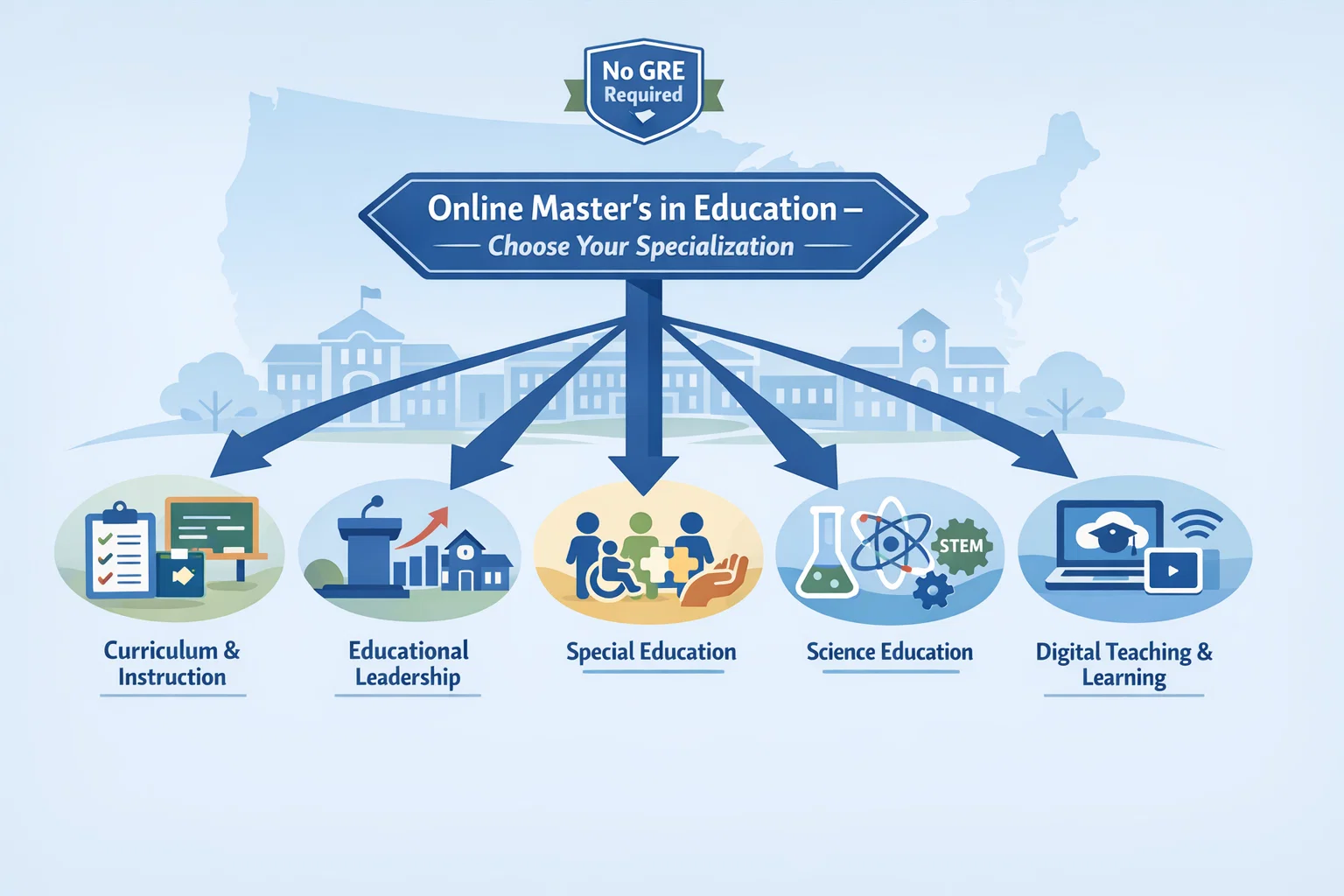
Curriculum and Instruction (Curriculum & Teaching)
A curriculum and instruction track is built for classroom improvement, instructional design, and school-based coaching. KU’s online master’s in curriculum & instruction states “No GRE required for admission” and highlights 8-week courses.
Educational Leadership (Education Administration)
Educational leadership fits aspiring department leads, instructional coordinators, and administration tracks. KU’s online education administration master’s lists “No GRE required for admission” and includes a building leadership track option.
UGA’s online M.Ed. in Educational Administration & Policy states no GRE/MAT test scores required.
Special Education
Special education tracks commonly include autism, high-incidence disabilities, and intervention models. KU lists an online master’s in autism and related options, with program pages stating no GRE required.
Science Education
Science education programs often sit inside a College of Education and connect to teacher education and assessment research. UGA’s faculty directory highlights science education and teacher education expertise (example: Julie M. Kittleson).
UGA also lists Xiaoming Zhai in science education and AI-focused STEM education work; an external profile notes NSF-funded projects.
Digital Teaching and Learning (Educational Technology)
Digital teaching and learning tracks focus on virtual classroom leadership, asynchronous learning design, online learning accessibility, digital citizenship education, and digital equity advocacy. KU also offers online endorsements such as TESOL, listing no GRE required.
Sample courses you’ll actually see in online MSEd programs
Course names differ by university, but these examples show the level and focus.
-
EDU 610: Differentiation Theory & Strategy (example course listing in UNE’s graduate offerings ecosystem)
-
EDU 620: Ethical Responsibilities in Today’s Educational Systems (UNE Online course description)
Courses like these map to common outcomes: culturally responsive pedagogy, innovative assessment techniques, personalized curriculum design, and educational policy analysis.
Accreditation checks that matter
Accreditation protects credit transfer, employer recognition, and financial aid eligibility.
Institutional accreditation (example: Higher Learning Commission)
Purdue Global states it is accredited by the Higher Learning Commission (HLC).
Capella states HLC accreditation on its official “About” pages.
Program quality signals (example: CAEP/NCATE alignment)
Some education schools cite CAEP/NCATE standards alignment on program pages. KU’s online education master’s pages reference accreditation under NCATE/CAEP standards.
If the goal is licensure, confirm state authorization and licensure disclosures for the program.
Admissions: a no-GRE online program still needs a clean application
Use this checklist and treat it as the minimum.
Application checklist
-
Transcripts from every college attended
-
Resume/CV (highlight classroom, training, coaching, or learning & development work)
-
Personal statement (pick one: career change, leadership goal, specialization goal)
-
Letters of recommendation (supervisor + educator/mentor is common)
-
Proof of teaching license, if applying to a licensure track
-
Writing sample, if requested (less common in practitioner-focused programs)
Set a target date
Pick a personal submission date that is earlier than the school’s posted deadline. A simple target is February 23, 2026 for a spring intake plan, then adjust to the program’s real deadline once confirmed.
Tuition and cost: how to lower the real price
If the goal is “affordable online MSEd,” price per credit is only part of the cost. Use these levers:
Transfer credits
Ask the admissions team:
-
Maximum transfer credits accepted
-
Minimum grade needed for transfer
-
Time limit on prior coursework
-
Whether transfer credits reduce both time and tuition
Employer and system tuition benefits
If employed inside a large university system, check tuition assistance programs. The University System of Georgia Tuition Assistance Program (TAP) is an example of an employee education benefit program.
Corporate partner benefits and military tuition reduction
Many universities run corporate partner discounts and military tuition reductions. Always ask for the exact policy and whether it applies to online education graduate programs.
Student experience: what “online program” should include
A usable online master’s program includes:
-
Clear weekly structure and fast feedback
-
Live sessions or structured interaction when required
-
Office hours and academic support
-
Practicum or internship coordination if the track requires fieldwork
-
Alumni network access (many universities run an Alumni Association)
Pepperdine’s online MSEd page describes small class sizes and an “Online Pepperdine University Student Experience” section on the program page.
Career outcomes: roles an online MSEd/M.Ed. supports
An online master’s in education can support:
-
Instructional coach / instructional coordinator
-
Curriculum specialist
-
Department lead
-
Special education coordinator
-
Education technology or digital learning specialist
-
TESOL specialist (often with endorsement requirements)
-
Training and development roles in corporate learning (adult and continuing education)
If teaching is not the goal, choose curriculum design, instructional design, or educational leadership tracks that fit non-K–12 roles.
Frequently asked questions
Can you get your master’s in education online without the GRE?
Yes, many online MSEd/M.Ed. programs do not require the GRE. Pepperdine, Purdue Global, UNE Online, KU program pages, and Capella all state no GRE (or no standardized tests) on program pages.
Are “no GRE” programs lower quality?
No GRE required does not automatically mean lower quality. Accreditation and program outcomes matter more than test policies. Purdue Global and Capella both reference Higher Learning Commission (HLC) accreditation on official pages.
Does “no GRE required” apply to every track at a university?
Not always. UNT’s education pages state GRE is not required, while also noting conditions for some situations or tracks. Always confirm the exact specialization page.
What if the goal is special education or autism?
KU has online special education pathways (example: autism master’s) that state no GRE required on the program pages.