
Introduction
An online Master of Science in Education (MSEd) is a graduate degree that builds advanced teaching, leadership, and learning-design skills through an online program format. An online master of science in education usually combines core courses (research, ethics, assessment, learning theory), a concentration (such as curriculum and instruction or educational leadership), and a capstone that applies data-driven instructional strategies to real work in schools, districts, higher education, or training teams.
Online MSEd degree formats are built for working adults. Many online MSEd programs use weekly modules, live class sessions, and project-based work that supports virtual classroom leadership, digital equity advocacy, and culturally responsive pedagogy. Pepperdine University’s Online MS in Education, for example, lists a 15-month structure, live online sessions, no GRE requirement, and an optional in-person Malibu immersion weekend.
Overview of Master’s in Education Programs
A Master’s in Education can be a Master of Science in Education (MSEd), a Master of Education (M.Ed.), or a Master of Arts in Teaching (MAT). An MS in Education program often leans into applied research, analytics, and program evaluation, while an MAT program is often designed around classroom teaching preparation. Many schools offer multiple pathways, including teacher education, educational studies, and leadership tracks.
Online Degree Options
You can get your masters in education online. Online master’s education programs are common across traditional universities and online-focused schools. Options include an online master of science in education, an online M.Ed., and online master’s teaching degrees like the MAT.
Online program choices often overlap with career goals:
-
Classroom impact: curriculum and instruction, reading, special education
-
Systems impact: educational leadership, higher education administration
-
Learning design impact: educational technology specialization, online learning accessibility, digital teaching and learning
Program Formats
Most programs come in fully online, hybrid, and campus-based formats.
Online Format
An online masters program typically uses a learning platform with weekly assignments, discussion, group work, and applied projects. Pepperdine’s Online MS in Education curriculum describes six core courses, concentration courses, and a capstone designed for online learning with applied work.
In-Person Malibu Immersion
Some online programs include an optional campus experience. Pepperdine University describes an optional, weekend-long Malibu immersion during the Fall term, hosted on the Malibu campus, with students responsible for travel and accommodation.
Program Length
Online MSEd programs commonly run 12–24 months, depending on pacing and credit load. Pepperdine University lists its Online MS in Education as 15 months.
Accreditation
Accreditation matters for financial aid, employer recognition, and credit transfer.
-
Institutional accreditation: Pepperdine University states it is accredited by the WASC Senior College and University Commission (WSCUC).
-
Other regional accreditors: Purdue Global and Capella University state they are accredited by the Higher Learning Commission (HLC).
-
What HLC does: HLC describes itself as an institutional accreditor that evaluates broad institutional quality.
Values Centered
Values-centered programs make ethics, inclusion, and social purpose part of the curriculum. Pepperdine highlights “Values Centered” language tied to its school values and admissions messaging.
Program Options & Specializations
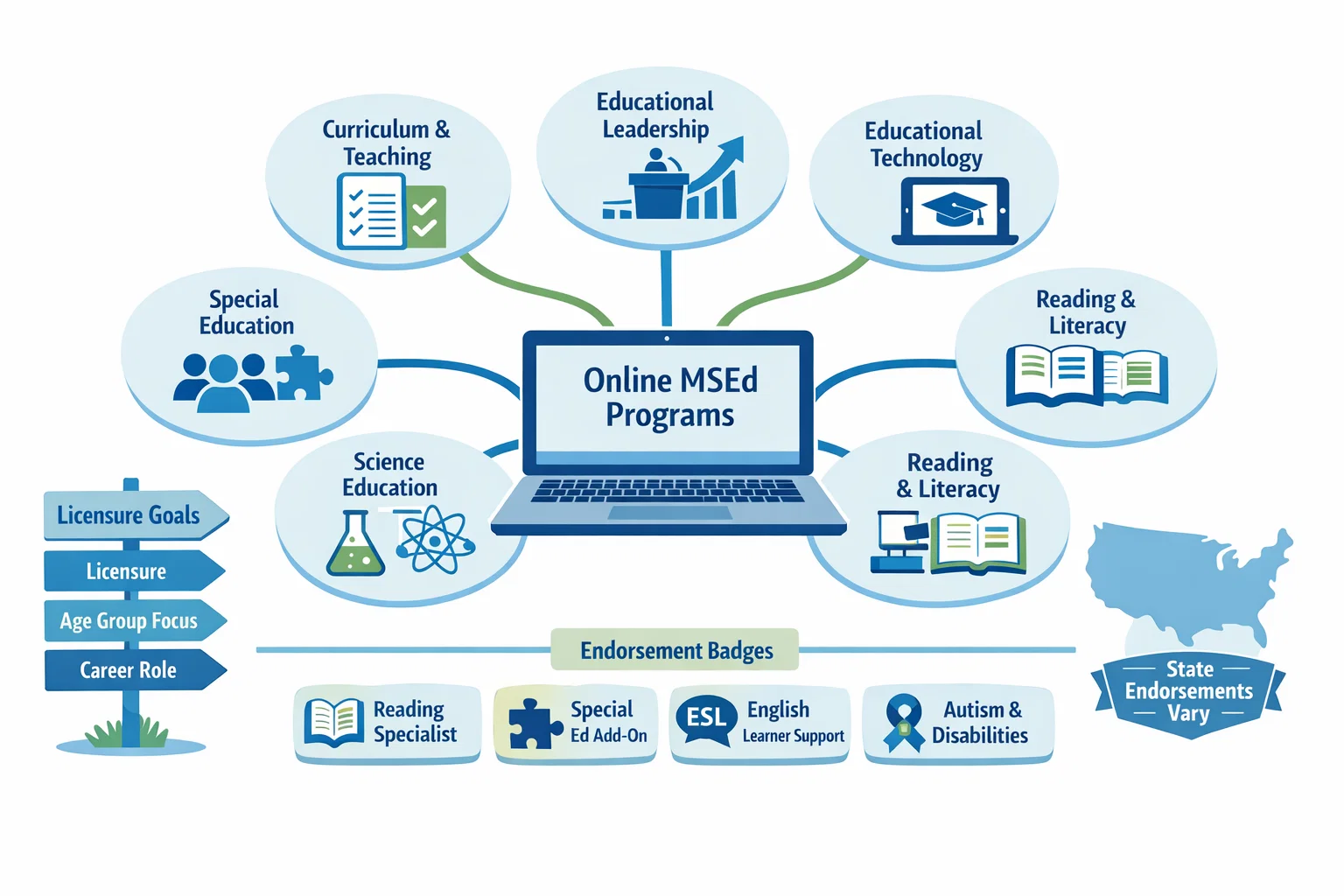
Online MSEd programs vary a lot. The best online MSEd fit depends on (1) licensure goals, (2) age group focus, and (3) whether you want curriculum development, leadership, or specialized support roles.
Concentrations/Specializations
Common concentration areas in masters education online programs include:
-
Curriculum and teaching
-
Educational leadership
-
Educational technology specialization
-
Special education
-
Science education
-
Reading and literacy
Pepperdine’s Online MS in Education lists four concentrations: Leadership in Learning Design and Technology, Leadership in Higher Education, Leadership in Pre-K to 12 Education, and Organizational Leadership and Learning.
Endorsement Programs
Endorsements depend on state rules, so check your state education agency. Common endorsement-style pathways include:
-
Reading specialist
-
Special education add-on licenses
-
English learner support
-
Autism and related disabilities support
Curriculum and Instruction
Curriculum and instruction tracks focus on personalized curriculum design, innovative assessment techniques, and lesson planning aligned to standards. Typical outputs include unit plans, assessment maps, and intervention plans.
Educational Leadership
Educational leadership tracks focus on school improvement planning, evaluation systems, and change management. Pepperdine’s curriculum includes core coursework on program design, evaluation, and applied analytics, which supports leadership and program evaluation roles.
Special Education
Special education tracks focus on inclusive practices, IEP-aligned planning, and collaboration with families and service providers. Many programs include coursework in differentiation, assistive technology, and behavior supports.
Science Education
Science education tracks focus on STEM instruction, lab learning, and evidence-based science teaching. At the University of Georgia (UGA), faculty profiles in the College of Education highlight science education and teacher education expertise (for example, Julie M. Kittleson).
Teacher Education
Teacher education pathways focus on instructional practice, classroom management, and supervised teaching experiences. This is the area where a Master of Arts in Teaching (MAT) is often used when the goal is initial classroom preparation.
Educational Studies
Educational studies tracks often support roles outside K–12 classrooms, including training, program coordination, education policy analysis, and adult learning.
Practitioner
Practitioner tracks focus on applied problem solving in real settings (schools, districts, nonprofits, corporate learning). Capstones often use remote mentorship programs and data analysis to solve a local instruction or program issue.
Student Teaching Concentration/Deaf Education Specialization
A student teaching concentration is usually tied to licensure. Deaf education specialization commonly involves language development and accessibility, including American Sign Language Education when offered.
Reading Specialist
Reading specialist pathways often focus on literacy assessment, intervention systems, and school-wide reading supports, with heavy emphasis on data-driven instructional strategies.
Autism and Related Disabilities
These programs focus on behavior supports, communication strategies, family collaboration, and inclusive classroom planning.
Intervention Specialist Mild – Moderate Disabilities
This track typically prepares educators to design and monitor supports for students with mild to moderate disabilities across subjects and settings.
Digital Teaching and Learning
Digital teaching and learning tracks focus on asynchronous learning design, digital citizenship education, and online learning accessibility, including mobile learning strategies and adaptive learning integration.
Curriculum and Courses
Curricula differ, but most online MSEd programs include learning theory, ethics, assessment, and leadership or instruction-focused courses, plus electives and a capstone.
Sample Courses
Here are real examples of graduate education courses that match common MS in Education outcomes:
-
EDMS 601 Critical Thinking and Communications (Pepperdine University)
-
EDMS 605 Applied Analytics and Data Visualization (Pepperdine University)
-
EDU 610: Differentiation Theory and Strategy (University of New England, UNE Online)
-
EDU 620: Ethical Responsibilities in Today’s Educational Systems (UNE Online)
Program Requirements
Most online MSEd programs require:
-
A set of core courses
-
Concentration or elective courses
-
A capstone project or applied portfolio
Pepperdine describes its Online MS in Education as a 30-credit curriculum with six core courses, three concentration courses, and a capstone integration experience.
Featured Courses
Featured courses in an online education masters often emphasize:
-
Ethics and inclusion
-
Learning design and evaluation
-
Applied analytics and assessment systems
-
Leadership for innovation and change
Pepperdine’s core courses include Ethics, Values, and Inclusion and Program Design and Evaluation, and the program ends with a capstone integration experience.
MSEd Core Courses
Common MSEd core themes:
-
Critical thinking and communication
-
Educational ethics and responsible leadership
-
Program evaluation
-
Data analysis and assessment literacy
Pepperdine’s Online MS in Education lists these themes directly in its EDMS core sequence.
MSEd Electives
Electives vary by school and concentration. Common electives include:
-
Digital teaching tools and learning analytics
-
Special education interventions
-
Literacy assessment systems
-
Educational policy analysis
-
Gamified learning environments and AI tutoring (often framed as educational technology topics)
Admissions
Admissions steps differ by school, but most follow a standard graduate process.
Admission Requirements
Most online MSEd programs require a bachelor’s degree and transcripts. Pepperdine’s Online MS in Education admission page lists a bachelor’s degree from a regionally accredited institution and a preferred minimum 3.0 GPA, plus recommendations and a personal statement.
Application Deadlines
Deadlines are term-based. Pepperdine posts specific deadlines for the Online MS in Education, including early and final completion deadlines for fall enrollment.
If you want a simple planning rule, set a personal “file complete” target date (for example, February 23, 2026) and work backward to collect transcripts, recommendations, and your statement.
Application Checklist
A typical checklist includes:
-
Online application
-
Transcripts (official may be required after acceptance)
-
Letters of recommendation
-
Personal statement
-
Interview (some programs use it as a secondary review)
Pepperdine lists these items and notes that unofficial transcripts may be used for initial review while official documents are needed to complete the file for enrollment.
No GRE or standardized tests required
Many education graduate programs do not require the Graduate Record Examination (GRE). Pepperdine’s Online MS in Education page states no GRE or standardized tests required.