
Introduction
A master’s in educational leadership is one of the most common routes to becoming a school principal in the U.S. Most schools expect a master’s degree in education administration or leadership plus teaching experience.
This guide breaks down the principal career path, what the degree teaches, what licensure usually requires, and how long it takes.
What a master’s in educational leadership does for aspiring principals
A Master of Education (M.Ed.) or Master of Science in Education (MSEd/MS in Education) in educational leadership builds the skills principals use daily:
-
instructional leadership and teacher coaching
-
school law, ethics, and professional norms
-
student support systems and school climate
-
data use for improvement plans
-
budgeting, staffing, and operations
-
family and community communication
The Bureau of Labor Statistics (BLS) lists the principal role as overseeing school operations, coordinating curriculum, managing staff, and using student achievement data to guide decisions.
Principal career path (step-by-step)
1) Become a licensed teacher and teach long enough to qualify
Typical expectation: 5 years or more of related work experience before moving into principal roles.
States and districts set the exact threshold, but most principal pipelines start with classroom teaching.
2) Build leadership experience before the title
School systems often prefer candidates who have already led something measurable, such as:
-
grade-level lead or department chair
-
instructional coach
-
MTSS/RTI lead
-
testing coordinator
-
dean of students or activities director
3) Earn a master’s in educational leadership with a principal-aligned track
Look for a program that clearly supports building-level leadership. Many programs include:
-
leadership coursework
-
field-based clinical practice
-
an internship or practicum under a mentor
Example: the University of Georgia (UGA) online M.Ed. in Educational Administration and Policy (Tier 1 School Leadership Track) describes a two-year format designed for working professionals and includes clinical practice experiences under a mentor.
4) Complete internship/clinical requirements and document competencies
Internship expectations vary by state and program, but “real school work” is a consistent theme.
Example: the University of Kansas (KU) online master’s in educational administration offers a building leadership track with online coursework plus an on-site internship.
5) Meet state principal licensure requirements
Licensure is state-run. Common components:
-
approved leadership preparation program
-
supervised clinical hours/internship
-
required exams (varies by state)
-
background checks and educator credential status
UGA’s Tier 1 School Leadership Track shows how state-specific this can be by listing Georgia certification requirements inside the admissions section.
6) Move into assistant principal, then principal
A common ladder is:
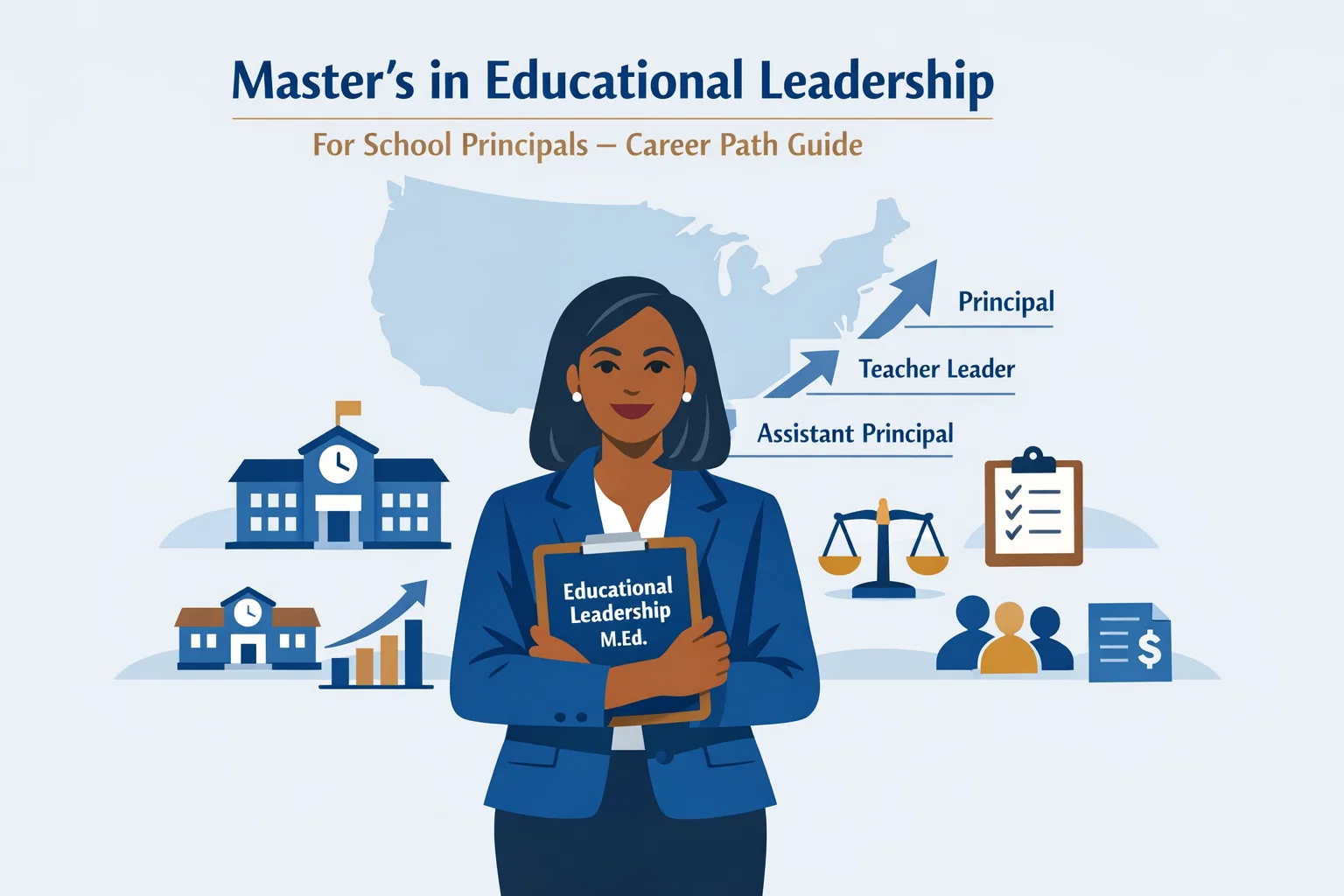
Teacher → Teacher leader → Assistant Principal (AP) → Principal
Some districts hire directly into principal roles for experienced APs, deans, or leaders with strong district backing.
How long it takes to become a principal
A realistic timeline in many districts looks like this:
-
Undergrad + teacher licensure: 4 years (varies)
-
Teaching + leadership roles: often 5+ years before principal eligibility becomes realistic
-
Master’s program: commonly 18–24 months (varies by program)
-
AP to principal: 1–5 years depending on openings, performance, and district needs
BLS lists the typical entry-level education as a master’s degree and related work experience of 5 years or more for principals.
What you learn (useful frameworks schools recognize)
Professional Standards for Educational Leaders (PSEL)
Many leadership programs map coursework to the Professional Standards for Educational Leaders (PSEL) 2015. The standards cover 10 areas, including mission/vision, ethics, equity, curriculum and instruction, community engagement, operations, and continuous improvement.
A principal-focused master’s should leave you able to do work that matches these categories:
-
set mission/vision and build staff alignment
-
run teacher observation and feedback cycles
-
lead school improvement planning using data
-
manage budgets, staffing, and compliance
-
build family/community trust and communication systems
What to look for in a master’s program if the goal is “principal”
1) A clear licensure or building leadership pathway
Some programs are designed for licensure; others are “leadership skills” degrees that do not lead to principal certification.
-
Licensure-aligned example: KU offers a building leadership track with an internship and also a non-licensure track.
-
State-aligned example: UGA’s Tier 1 track is built around Georgia’s leadership certification pathway and includes clinical practice.
2) Internship structure you can actually complete
Ask these questions before applying:
-
where the internship happens (your school vs assigned site)
-
who qualifies as a mentor
-
how performance is evaluated (portfolio, rubric, observations)
KU states that building leadership students complete an administrative internship and a final portfolio project tied to the internship experience.
3) Accreditation signals
For institutional and educator-prep quality, look for:
-
university-level accreditation (regional accreditors vary by region)
-
educator preparation quality signals (often CAEP-related in the U.S.)
CAEP describes its role as advancing educator preparation through evidence-based accreditation and continuous improvement.
Online vs in-person formats for aspiring principals
Online master’s programs (common)
Online programs work well if you already work in a school and can complete clinical experiences locally.
Examples:
-
KU’s online educational administration master’s uses 8-week courses, can be finished in as few as 2 years, and includes an on-site internship for the building leadership track.
-
UGA’s online Tier 1 track includes asynchronous and synchronous work plus clinical practice experiences.
Online leadership degrees that may not equal principal licensure
Some programs focus on leadership development across education settings rather than state principal certification.
Example: Pepperdine University’s online MS in Education states no GRE or standardized tests required and notes a 15-month timeline with synchronous live sessions.
That can fit leadership growth goals, but principal licensure still depends on state rules and program design.
Admissions: what schools usually want
Even when the GRE is not required, programs still screen for readiness and fit.
Common requirements
-
bachelor’s degree transcripts
-
resume with school experience
-
letters of recommendation
-
statement of purpose tied to leadership goals
-
proof of educator certification, if the track requires it
UGA’s Tier 1 track lists admissions minimums that include holding a bachelor’s degree and holding a clear, renewable Georgia professional educator certification (for that pathway).
“No GRE” is common in education leadership admissions
-
KU states no GRE required for admission for its online educational administration master’s.
-
Pepperdine’s online MS in Education states no GRE or standardized tests required.
-
Capella’s MS in Education program states GRE and GMAT are not required.
Salary and job outlook for principals (U.S.)
BLS reports the median annual wage for elementary, middle, and high school principals was $104,070 in May 2024.
BLS projects employment for principals to decline 2% from 2024 to 2034, while still expecting about 20,800 openings per year due to replacement needs.
Skills principals use (and what to build during the master’s)
A principal hiring panel looks for proof of these skills:
-
Instructional leadership: observation, coaching, PD planning
-
Data-driven improvement: test score analysis and progress monitoring
-
Operations and budget: staffing, schedules, budget management
-
Culture and behavior systems: discipline frameworks, attendance systems, student support
-
Family/community communication: conflict handling, trust-building, transparency
-
Ethics and compliance: standards-aligned leadership and professional norms
If you want a “master leadership” profile that reads strong on a resume, attach each skill to a measurable outcome (attendance change, discipline reduction, literacy gains, teacher retention).
Behavioral interview questions for future principals (examples)
Use a tight structure: context → action → metric → reflection.
-
“Describe a time you improved student outcomes using data.”
-
“Describe a time you coached an underperforming teacher.”
-
“Describe a time you handled a parent conflict that escalated.”
-
“Describe a time you managed a major schedule or staffing issue.”
-
“Describe a time you led a change that staff resisted.”
-
“Describe a time you had to act on an ethical concern.” (PSEL ethics is a common frame.)
Practical plan for the next 60 days (principal track)
Week 1–2
-
Pick the state where you want principal licensure.
-
Write a 1-page “principal target” document: grade band, district type, and the leadership gaps you can solve.
Week 3–4
-
Shortlist 5 programs and verify: licensure alignment, internship requirements, and format.
-
Ask each program’s admissions team: “Does this program meet principal licensure requirements in my state?”
Week 5–8
-
Collect transcripts and recommendations.
-
Write a statement that connects leadership goals to real school results.
-
Set a submission target date like February 23, 2026 to avoid transcript delays.
FAQs
Do you need a master’s to become a principal?
Yes, in most U.S. schools, principals need a master’s degree in education administration or leadership plus teaching experience.
Can you do a master’s in educational leadership online and still become a principal?
Yes, if the program includes the clinical/internship work required for your state. KU, for example, lists an on-site internship for its building leadership track.
What’s the fastest credible path to principal?
A common fast path looks like: teacher → teacher leader/instructional coach → assistant principal → principal. Your timeline depends on district openings and whether you already lead schoolwide projects.