

Key Takeaways
- Miami car insurance costs more than many Florida cities because ZIP code, traffic density, theft risk, weather exposure, and claim frequency all raise premiums.
- Florida requires at least $10,000 in Personal Injury Protection (PIP) and $10,000 in Property Damage Liability (PDL) for registered vehicles.
- The fastest way to lower costs is to compare the same coverage across several insurers instead of choosing the cheapest advertised rate.
- Driver age, driving history, vehicle type, selected coverages, and credit score can all change Miami car insurance quotes in a major way.
- Cheap car insurance is not always the best car insurance, since low-priced policies can leave out collision, comprehensive, uninsured motorist coverage, or rental reimbursement.
Introduction
Car insurance quotes Miami shoppers compare are price estimates for the same driver across different insurers, coverages, deductibles, and ZIP codes. The main benefit is simple: comparing quotes helps Miami drivers find lower premiums, stronger protection, or both.
The main use is choosing the right mix of liability, collision, comprehensive, uninsured motorist coverage, Personal Injury Protection (PIP), and extras like roadside assistance.
The main parts of a Miami auto insurance quote are the driver profile, vehicle details, garaging ZIP code, selected coverages, deductible amount, discounts, and insurer underwriting rules.
In Miami, Florida, those parts matter more than many drivers expect because age, driving history, vehicle location, vehicle type, and credit score can change the price fast.
Florida law adds another layer by requiring PIP and property damage liability (PDL) for registered vehicles.
Understanding Car Insurance in Miami
Miami car insurance is auto coverage written for drivers in one of the most expensive insurance markets in Florida.
Miami rates tend to run high because insurers price in dense traffic, theft risk, severe weather exposure, claim frequency, fraud risk, and local crash patterns.
Recent 2026 comparison data puts the average Miami premium around $228 per month overall, while one separate 2026 dataset puts average full coverage in Miami near $389 per month and state minimum near $144 per month. The exact number changes by methodology, so the smartest move is to compare multiple live quotes instead of relying on a single average.
Quick Facts
Miami drivers must carry at least $10,000 in PIP and $10,000 in PDL to register and keep a vehicle on the road in Florida.
Florida is a no-fault state, so PIP pays first for covered medical bills regardless of fault. Miami rates are usually higher than the Florida average.
A move from one Miami ZIP code to another can change the premium.
Full coverage is not required by Florida law for most private passenger vehicles, but lenders usually require it on financed or leased cars.
Miami Car Insurance Requirements
Florida requires proof of insurance at registration and continuous coverage during the registration period. For most private passenger vehicles, the legal minimum is $10,000 PIP plus $10,000 PDL. Florida does not generally require bodily injury liability (BIL) for every driver before a crash, but BIL can become necessary after certain violations or serious at-fault crashes, and lenders may require broader protection on financed vehicles.
Is Auto Insurance Mandatory in Florida?
Yes, auto insurance is mandatory in Florida for vehicles with a current Florida registration. A registered vehicle must be insured with at least $10,000 in PIP and $10,000 in PDL. The policy must be issued by an insurer licensed in Florida, and coverage must stay in force through the registration period.
What Does a Minimum Policy in Florida Include?
A Florida minimum policy includes two parts: Personal Injury Protection (PIP) and Property Damage Liability (PDL). PIP pays 80% of necessary and reasonable medical expenses for covered injuries, up to the policy limit, and care must begin within 14 days after the crash. PDL pays for damage you cause to another person’s property.
What are the Penalties for Driving Without Insurance in Miami?
Driving without required insurance in Miami can lead to suspension of your driver license and registration. Florida says failure to maintain required PIP and PDL may trigger reinstatement fees ranging from $150 to $500. After certain at-fault crashes, the driver may also need to file an SR-22 and maintain higher limits for three years.
Is it Legal to Drive Without Full Coverage?
Yes, it is legal to drive without full coverage in Florida, if you still carry the state-required minimum coverage. Full coverage is a common name for a policy that usually adds collision and comprehensive coverage to the legal minimum or other liability limits. Florida law does not require full coverage for most private passenger vehicles, but a bank or leasing company usually does.
Is Florida a No-Fault State?
Yes, Florida is a no-fault state. That means your own PIP coverage pays first for your covered medical costs after a crash, regardless of who caused the accident. No-fault does not mean every loss is fully covered. Vehicle damage, serious injury claims, and lawsuits can still involve liability questions and other coverages.
What is PIP and why is it mandatory in Florida?
PIP means Personal Injury Protection (PIP). Florida makes PIP mandatory because the state’s no-fault system uses it as the first layer of injury coverage after a crash. PIP pays 80% of necessary and reasonable medical expenses for covered injuries, subject to the policy limit and timing rules. In practice, PIP helps Miami drivers get early medical payments without waiting for fault to be resolved.
Factors Affecting Car Insurance Costs in Miami
Driver’s Age and Experience
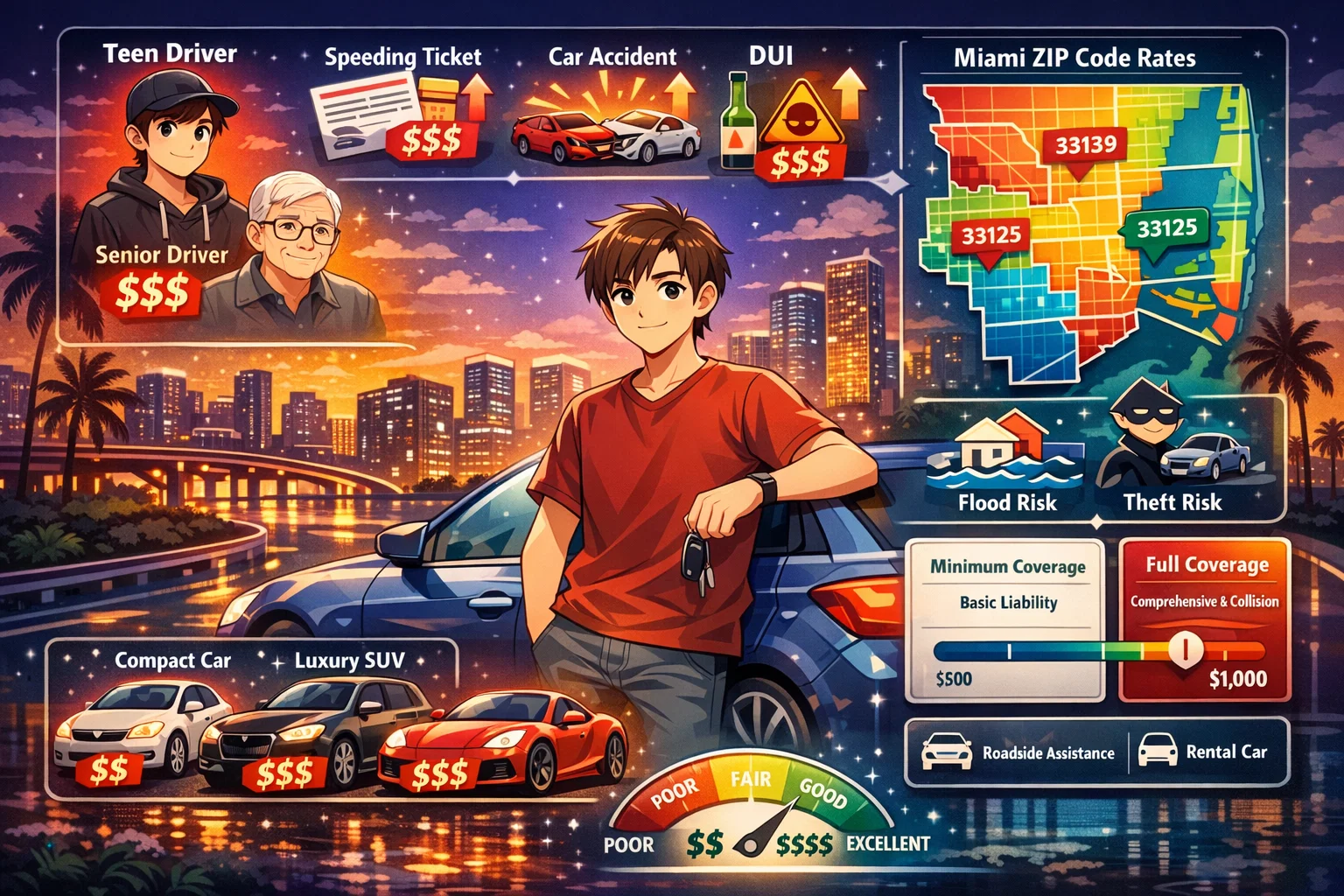
Age is one of the biggest pricing factors in Miami car insurance quotes. Teen drivers and very young drivers pay the most because insurers see less driving experience and higher claim risk. Rates usually improve through the late 20s and 30s, then can edge up again around age 70. Florida comparison data shows teens can pay far more than older drivers, while senior rates often stay moderate until later years.
Driving History
Driving history affects price fast. A clean record usually gets the best rates. A speeding ticket, an at-fault accident, or a DUI can move a driver into a higher-risk tier. Florida comparison data for 2026 shows major jumps after accidents and DUIs, and the effect can last for years. A DUI is especially costly in Florida and may require an FR-44 or SR-22-related filing depending on the case.
Vehicle Location
Vehicle location means more than the city name. Insurers price by garaging address and ZIP code. In Miami, even nearby neighborhoods can carry different theft, vandalism, flood, and accident risk. Recent Miami ZIP code comparisons show full-coverage averages from roughly $4,334 to $4,565 per year among listed ZIP codes, which shows how local pricing can be.
Vehicle Type Insured
Vehicle type matters because repair costs, theft rates, horsepower, safety features, and claim patterns differ by model. A compact commuter car usually costs less to insure than a luxury SUV, a sports coupe, or a modified vehicle. Luxury vehicle coverage, classic car insurance, custom vehicle coverage, and rideshare driver policies all price differently because the underlying risk is different. Florida’s rate comparison framework explicitly treats vehicle type as a core pricing factor.
Selected Coverages
Coverage level changes premium more than almost any other choice you control. Minimum coverage costs less than full coverage. Lower deductibles raise the premium. Higher liability limits, rental car reimbursement, roadside assistance, gap insurance, and deductible waiver options can raise the price, but they can also prevent much larger out-of-pocket costs after a loss. Florida’s official comparison tool lists type and amount of coverage among the main rating factors.
Credit Score
Florida insurers can use credit-based insurance scoring, though credit cannot be the only rating factor. In practice, drivers with better credit often see lower rates, while drivers with poor credit often pay much more. That is one reason two Miami drivers with the same car and driving record can still get very different quotes.
Car Insurance Coverage Options in Miami
Liability Insurance
Liability insurance pays for damage or injuries you cause to others, subject to policy limits. In Florida, the required minimum for most registered private passenger vehicles is property damage liability, not broad bodily injury liability for every driver before a crash. Many Miami drivers still buy higher liability limits and optional bodily injury liability because the state minimum can run out fast after a serious claim.
Collision Coverage
Collision coverage pays to repair or replace your car after a crash, regardless of who caused it, subject to the deductible. Miami drivers with newer cars, financed cars, or limited savings often keep collision coverage because repairs can be expensive.
Comprehensive Coverage
Comprehensive coverage pays for non-collision losses such as theft, vandalism, falling objects, fire, flood, and storm damage. In Miami, comprehensive coverage often matters because of hurricane season, flooding, and theft risk.
Uninsured/Underinsured Motorist Coverage
Uninsured/underinsured motorist coverage helps when the other driver does not have enough insurance. Florida’s minimum system does not require bodily injury liability for every driver up front, so uninsured motorist protection can be valuable in Miami.
Personal Injury Protection (PIP)
PIP is mandatory in Florida. PIP pays 80% of necessary and reasonable medical expenses for covered injuries, subject to the limit and the 14-day initial treatment rule.
Roadside Assistance
Roadside assistance can cover towing, battery service, lockout help, fuel delivery, and flat-tire service. It is optional, but many Miami drivers add it because the cost is usually modest.
Additional Car Insurance Coverages to Consider
Useful add-ons in Miami include rental car reimbursement, gap insurance quotes for financed vehicles, rideshare driver policies for Uber or Lyft work, non-owner liability coverage, accident forgiveness programs, classic car insurance, modified vehicle insurance, and commercial auto solutions for business use. Drivers who want lower emissions sometimes compare hybrid or EV options partly to cut fuel use and CO₂ output, but they should still check repair-cost effects before assuming a lower insurance premium.
How to Find Affordable Car Insurance in Miami
Strategies to Reduce Your Insurance Premium
Compare at least three quotes for the same coverage, raise the deductible only if you can afford it, bundle policies, ask about telematics or usage based insurance, keep a clean record, and review the garaging ZIP if you move. Miami drivers often save more by adjusting coverage structure than by chasing the very lowest advertised rate.
Savings Comparison by Strategy
A practical savings order looks like this: compare quotes first, review discounts second, bundle third, adjust deductibles fourth, and remove coverage only after you measure the risk. Florida’s market has shown signs of easing, with the state Office of Insurance Regulation saying the top five auto writer groups are currently indicating an average 8% rate change downward for 2026, but local Miami premiums still remain high enough that quote comparison matters.
Useful Tips for Saving
Ask for paperless billing, autopay, multi-car discounts, safe-driver discounts, good-student discounts, defensive-driving discounts, and low-mileage pricing. If you drive for Uber or Lyft, ask for a rideshare endorsement instead of assuming your personal policy is enough. If you use a digital insurer or a Lemonade app-style mobile experience for other products, still compare the actual auto coverage terms line by line before buying.
Car Insurance Discounts
Common discounts include safe driver, good student, multi-policy, multi-vehicle, homeowner, anti-theft device, paid-in-full, paperless, autopay, and telematics discounts. Some Miami agencies and local car insurance offices offer bilingual service in Spanish, which can help shoppers compare endorsements and exclusions more accurately.
How to Save Without Reducing Your Protection?
Keep higher liability limits if you have assets to protect, then lower the premium by shopping carriers, bundling, improving credit, using discounts, and choosing a deductible that matches your emergency fund. Saving without reducing protection usually means buying smarter, not buying less.
Common Mistakes When Choosing Car Insurance
Buying Based on Price Alone
The cheapest quote can be the wrong quote if it strips out collision, comprehensive, uninsured motorist protection, or rental coverage.
Not Comparing Coverages
Two Miami insurance quotes can have the same monthly price and very different deductibles, liability limits, and exclusions.
Ignoring Deductibles
A lower premium with a $1,500 deductible is not a bargain if you cannot pay that amount after a claim.
Not Considering Credit History
Credit score can affect the premium in Florida, so many drivers pay more than needed just by skipping a credit review.
Not Asking for Discounts
Many shoppers miss discounts for safe driving, students, paperless billing, multi-policy bundling rates, or telematics.
Not Consulting an Agent
An independent agent can help when a driver has a teen in the household, a DUI, a rideshare job, a modified car, or a non-owner policy need. Local agencies such as Univista Insurance or Estrella Insurance may appeal to drivers who want in-person help and Spanish-language service, while direct carriers such as GEICO or Mercury may appeal to drivers who want to compare online and buy fast.
Car Insurance Rates and Costs in Miami
How Much Does Car Insurance Cost in Miami?
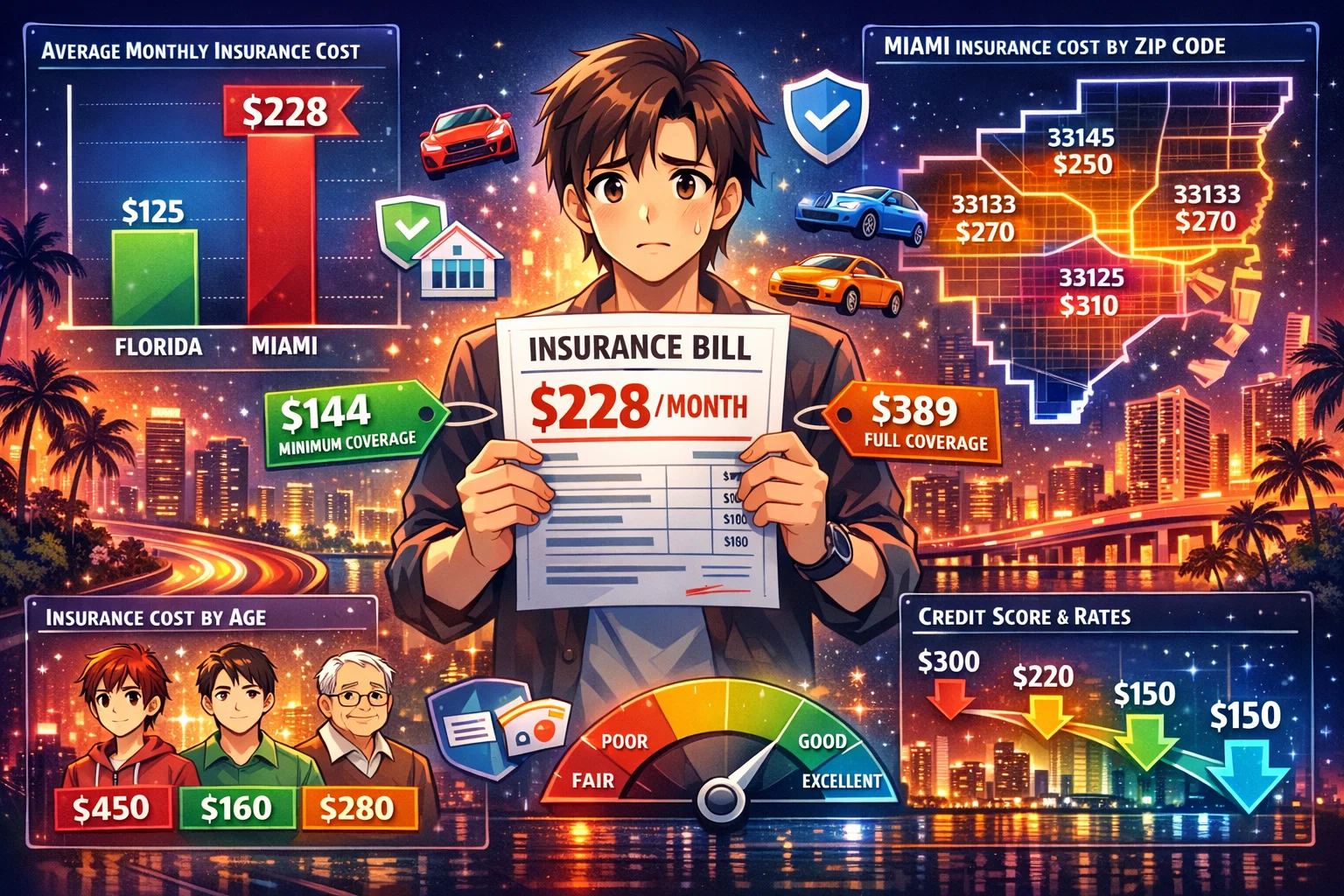
Car insurance in Miami is expensive. Recent 2026 data places the average Miami premium at about $228 per month overall in one dataset, while another source estimates about $144 per month for state minimum coverage and about $389 per month for full coverage. Those figures are not identical because quote methodologies differ, but both show the same pattern: Miami is well above many Florida markets.
Average Car Insurance Cost in Miami and Florida
Florida averages vary by source and coverage definition. Insurify currently shows Florida averages near $165 per month for liability-only coverage and $204 per month for full coverage. Bankrate’s statewide study shows higher averages at about $88 per month for minimum coverage and $324 per month for full coverage. Miami sits above those Florida baselines in most comparisons.
Factors Allowed in Miami Car Insurance Rates
Florida’s official CHOICES tool says auto rates vary significantly based on who is covered, type of vehicle, type of coverage, amount of coverage, and geographic location. In plain terms, insurers can price for age, experience, address, car type, and coverage choices, and many also use credit-based insurance scoring where permitted.
Miami Car Insurance Rates by Zip Code
Miami ZIP code matters. One recent 2026 comparison for full coverage lists 33145 at about $4,334 annually, 33133 at $4,438, 33125 at $4,461, 33131 at $4,482, and 33194 at $4,565. That spread shows why Miami car insurance quotes should always be run with the exact garaging address.
Miami Car Insurance Rates by Age
Age changes Miami pricing sharply. Florida comparison data shows teens can pay far more than mature drivers, rates usually improve through the 30s and 40s, and rates can rise again around age 70. For planning purposes, teen drivers should expect the highest quotes, middle-aged drivers the lowest range, and seniors a modest late-life increase depending on record and carrier.
Miami Car Insurance Cost by Credit Score
Credit score affects Miami car insurance cost in Florida. Drivers with excellent or good credit usually see lower premiums than drivers with fair or poor credit. That difference can be large enough to move one insurer from “expensive” to “cheapest” for the same driver profile.
Cheapest Car Insurance in Miami: Poor Credit
For poor-credit shoppers, there is no single insurer that wins every profile in Miami. In Florida comparison datasets, carriers such as GEICO, Progressive, State Farm, Mile Auto, and Mercury often show up among lower-cost options depending on age, record, and coverage level. The best method is to compare live quotes from at least three carriers and one independent agency.
Miami Car Insurance Cost by Driving Record
Driving record changes the price fast. A single speeding ticket usually raises rates, an at-fault accident raises them more, and a DUI often produces the steepest increase. Florida comparison pages for major cities show the same pattern across insurers and driver groups.
Cheapest Car Insurance in Miami: Speeding Ticket
After a speeding ticket, comparison-first carriers such as Progressive, GEICO, State Farm, and sometimes Mercury often stay competitive in Florida. The cheapest Miami insurer can still change by age, ZIP code, and coverage selection, so the strongest advice is to rerun quotes right after renewal rather than auto-renewing.
Cheapest Car Insurance in Miami: At-Fault Accident
After an at-fault accident, drivers should expect fewer low-cost options and larger gaps between insurers. State Farm and Progressive often remain competitive in Florida comparison tables after accidents, while some specialty or nonstandard insurers become relevant for higher-risk drivers.
Cheapest Car Insurance in Miami: DUI
After a DUI, premiums usually jump the most. Florida city-level comparison data shows DUI drivers paying substantially more than clean-record drivers, and Florida may require proof of financial responsibility filing after serious violations. Shoppers in this category should compare standard carriers, nonstandard carriers, and independent agencies instead of relying on one brand.
Cities with the Highest and Lowest Car Insurance Rates in Florida
Recent 2026 sources do not use one identical ranking system, but they broadly agree that South Florida cities such as Miami and Palm Beach area locations rank among the most expensive, while lower-cost Florida markets are often inland or northern areas. Bankrate currently identifies Palm Beach as Florida’s most expensive city in one city-rate study and Santa Rosa Beach as the least expensive in that same study, while Insurify says Miami is the highest-cost city in Florida and Gainesville the lowest in its dataset. Tampa, Fort Lauderdale, Orlando, Kissimmee, St. Petersburg, Jacksonville, Tallahassee, St. Augustine, West Palm Beach, Cape Coral, and Hialeah all fall somewhere between those ends depending on source and driver profile.
Is Car Insurance More Expensive in Miami?
Yes, car insurance is usually more expensive in Miami. Recent data shows Miami premiums above Florida averages, and that matches what local drivers already see in live quote comparisons. High population density, claim frequency, weather exposure, theft, litigation pressure, and ZIP code differences all play a role.
Finding the Best Car Insurance Company in Miami
Cheapest Car Insurance Companies in Miami
The cheapest company in Miami changes by coverage level and driver profile. Recent 2026 sources point to Travelers as a low-cost option in one Miami ranking, while Florida-wide comparisons often show GEICO, Progressive, State Farm, and Mile Auto among cheaper carriers in many profiles. Mercury can be competitive for some drivers, though not always the cheapest.
Top-Rated Auto Insurance in Miami
Top-rated usually means a mix of price, claims experience, financial strength, and customer satisfaction. Florida comparison content regularly highlights GEICO, State Farm, Progressive, and Allstate among strong national brands, while local buyers sometimes prefer an agent-led experience through neighborhood offices that can explain options in English or Spanish.
Best Insurer for Teens
For teens, parents should compare staying on a family policy first. Florida quote comparisons often show State Farm and Progressive among stronger value options for younger drivers, though the winning carrier changes by household and school discount eligibility.
Best Insurer for Seniors
For seniors, low complaint handling, stable pricing, and good claims support matter more than headline ads. Florida comparison data suggests rates begin to rise around age 70, so seniors should compare every renewal cycle. State Farm, GEICO, and Mile Auto often appear in competitive positions depending on the city and profile.
Best Insurer for Drivers with an Accident
Drivers with an accident should compare standard insurers first, then independent agents who can shop nonstandard markets if needed. In Florida city comparison tables, State Farm and Progressive often remain competitive after at-fault accidents, but the best insurer still depends on the exact loss history.
Real Savings Stories in Florida
Customer Reviews about Car Insurance in Miami, Florida
Miami shoppers usually describe savings in one of three ways: switching after a renewal increase, bundling home and auto, or moving from minimum coverage shopping to real quote comparison by coverage line.
Luis cut his premium by raising the deductible from $500 to $1,000 and keeping uninsured motorist coverage. María saved by bundling and asking for every discount.
Carlos found a better price after correcting mileage. Elena reduced the premium after improving credit.
Juan and Ana compared a local agency with a direct carrier and discovered the cheaper quote had weaker rental coverage. Miguel, Lucía, Gabriel, Sofía, Sebastián, Isabella, Mateo, Camila, Andrés, Paula, Diego, Martina, Samuel, and Victoria all represent the same lesson: the premium changes when the details change. Real Miami savings usually come from comparison, not guesswork.
Getting a Car Insurance Quote in Miami
How to Get Car Insurance in Miami
Gather your driver license information, VIN, garaging ZIP code, current coverage page, estimated annual mileage, and household driver details. Then compare quotes from direct carriers like GEICO, captive-agent carriers, and at least one independent agency. Review liability limits, deductibles, collision, comprehensive, uninsured motorist, PIP, roadside assistance, and rental reimbursement before buying.
Getting a Free Auto Insurance Quote
Most online quote tools are free. A free auto insurance quote lets Miami drivers compare policy structure before paying anything. The key is to keep the coverage choices identical across insurers so the quote comparison is real.
Begin Your Free Online Quote
To begin your free online quote, enter your Miami ZIP code, vehicle details, driving history, and coverage choices, then compare at least three offers. For the best result, check one direct insurer, one large national carrier, and one local agency that understands Miami-Dade pricing.
Summary
Car insurance in Miami, Florida is shaped by state minimum coverage rules, no-fault insurance laws, and local risk factors that make rates higher than many other parts of the state.
Miami drivers must carry PIP and PDL, but many choose broader protection such as collision, comprehensive, and uninsured motorist coverage for better financial protection.
The cost of coverage depends on age, driving record, vehicle location, vehicle type, selected limits, and credit profile.
Drivers can often lower premiums by comparing multiple quotes, using discounts, adjusting deductibles carefully, and reviewing coverage instead of focusing on price alone. The best Miami car insurance quote is the one that balances cost, protection, and insurer quality.
Frequently Asked Questions (FAQs)
Is Auto Insurance Mandatory in Florida?
Yes. Florida requires at least $10,000 in PIP and $10,000 in PDL for registered vehicles.
What Happens If I Drive Without Insurance?
Your license and registration can be suspended, and reinstatement fees can range from $150 to $500. After some crashes, higher limits and an SR-22 filing may be required.
Which Companies Offer Good Prices?
Good prices often come from GEICO, Progressive, State Farm, Travelers, Mile Auto, and sometimes Mercury, but the cheapest company depends on your exact profile.
Can I Save Money If I Drive Less?
Yes. Lower annual mileage can reduce premiums with some insurers, and usage based insurance can help low-mileage drivers.